A Guide to Winning Open Calls for Artists
Open calls are, quite simply, public invitations for artists to submit their work. They could be for anything from exhibitions and grants to residencies or publications. For both emerging and established artists, this is one of the most direct ways to gain visibility, secure funding, and push your career forward. Think of them as a direct line to curators, collectors, and galleries.
What Are Open Calls for Artists?
Let's be honest, the art world can feel like an insiders' game, run by unwritten rules and closed-off networks. Open calls are the antidote to this. They create a far more transparent and accessible system for discovering new talent. At its heart, an open call is a democratic invitation that helps break down some of those traditional barriers.
Instead of just waiting for that lucky break, these opportunities empower you to find the venues and platforms that actually align with your work. They aren't just submission forms—they're strategic tools for building your career.
The Value of Pursuing Opportunities
The benefits of applying for open calls go well beyond just getting accepted. The process itself is an incredible professional workout. It forces you to constantly refine your artist statement, keep your portfolio sharp, and photograph your work professionally. Every single application is a masterclass in professional practice.
What’s more, these calls put your work directly in front of the people who can change your career's trajectory. The jurors are often influential curators, established gallery owners, or respected artists. Even if you aren't selected this time, you've planted a seed. You’re on their radar.
"An open call is an invitation for any artist to have their work considered for an exhibition, residency, prize, or grant… it’s a smart way to get your work seen by more eyes, including potential new collectors and galleries."
This kind of exposure is priceless. I once worked with an artist who had a single painting accepted into a group show at the Mall Galleries in London. She brilliantly used that one achievement as a springboard, organizing a small coffee morning for local interior designers centered around that piece. The result? Multiple commissions.
Types of Open Calls You Will Encounter
"Open call" is a broad term that covers a lot of ground. Each type of opportunity comes with its own goals and potential outcomes, so knowing the landscape helps you focus your energy where it counts.
- Exhibitions: This is the most common category. Opportunities can range from group shows at a neighborhood gallery to major international events like the Whitney Biennial.
- Grants and Fellowships: These offer direct financial support. The funding might be for a specific project or simply to cover living expenses, giving you precious, uninterrupted time to create.
- Artist Residencies: Residencies provide a dedicated space and time to work, often in a completely new environment. It’s a chance to explore your practice without the usual daily distractions.
- Prizes and Competitions: These are all about recognizing excellence, usually with significant cash prizes and a healthy dose of public recognition.
- Publications: Art magazines, journals, and online platforms often put out open calls for artist features, interviews, or inclusion in curated digital collections.
Each of these paths offers a different reward, from potential gallery representation to a stronger sense of community. For example, participating in group shows is one of the best ways to meet other artists and see how your work holds its own in the current conversation.
Building a foundation locally is also a smart move. You can learn more about how to engage with art community projects in your own area. Ultimately, open calls are the proactive artist’s most powerful tool for building a sustainable and visible career.
Where to Find High-Quality Open Calls for Artists

Knowing open calls are valuable is one thing, but finding the right ones is a different beast entirely. You can easily burn out scrolling through endless listings, many of which are low-quality or completely irrelevant to your work. The trick is to stop casting a wide, inefficient net and start focusing your search on trusted, curated platforms where serious organizations and artists connect.
By homing in on these dedicated resources, you cut through the noise. It’s about spending less time hunting and more time building a stellar application.
Premier Online Databases for Artists
For sheer volume and variety, the large, established online databases are the most efficient place to start. These platforms are the workhorses of the professional artist's toolkit, acting as central clearinghouses for everything from local gallery shows to international grants.
Take a platform like CaFÉ (CallForEntry.org) or ArtRabbit. They’re built to be comprehensive, letting you filter opportunities by location, medium, and type. This alone saves an incredible amount of time. You’ll find that many reputable institutions, from universities to municipal art programs, use these portals exclusively to manage their entire submission process.
A common mistake is treating all listing sites equally. I always prioritize platforms that require organizers to post a detailed prospectus. It's a clear signal of professionalism and transparency.
The only downside to these massive databases is their size. While the selection is unmatched, you have to be disciplined with your filters to pinpoint the calls that genuinely align with your practice and career goals.
Curated Listings and Art Publications
If the big databases feel overwhelming, curated listings offer a more focused, hand-picked approach. You’ll typically find these in established art magazines, respected blogs, and industry newsletters. Publications like Hyperallergic and Artnet regularly feature choice open calls, often highlighting prestigious or unique opportunities that might get buried on larger sites.
I highly recommend subscribing to newsletters from these sources. They deliver vetted calls straight to your inbox, so you never miss a deadline for an opportunity that could be a perfect fit. The editors behind these publications have a reputation to uphold, so they’re motivated to showcase high-caliber listings to their audience.
This curated path not only saves time but also adds a layer of credibility. If a respected art journal is promoting a call, it’s a strong vote of confidence in its legitimacy.
The Power of Local and Niche Communities
While global platforms are great, don't sleep on your local arts ecosystem. Honestly, some of my most significant career steps came from opportunities right in my own backyard. Your local or regional arts council is an invaluable resource, often posting grants, public art commissions, and exhibition calls specifically for artists in the area.
These local calls almost always have less competition, making them a fantastic way to build your CV and network with the people shaping the arts scene where you live. Beyond that, joining local groups or collectives can give you access to word-of-mouth opportunities that you’ll never find online. If you're looking for a starting point, our guide on finding art collectives near me is a great resource.
The good news is that finding these opportunities is getting easier. For instance, the landscape of open calls for artists in 2026 is expanding rapidly, with platforms like EntryThingy now aggregating over 1,900 legitimate listings. What’s really encouraging is that 616 of those calls have no entry fees, which lowers a major barrier for emerging artists. This reflects a 25-30% yearly growth rate per platform—a clear sign of a more accessible art world.
By combining broad searches on the major databases with a targeted focus on curated publications and local networks, you build a robust and sustainable strategy for finding the high-quality open calls that will actually move your career forward.
Choosing the Right Opportunities for Your Art
Trying to apply for every open call you find is a surefire way to burn yourself out. With so many opportunities available, success isn't about casting a wide net—it's about strategic, thoughtful selection. A targeted approach saves you time, money, and precious creative energy, making sure you only pursue the calls where your work has a real chance to connect.
The whole process starts with a careful read of the prospectus, which is the official document outlining all the details of the call. Look past the deadline and the entry fee. The most important clues are hidden in the theme, the specific media requirements, and the reputation of the organization hosting the event.
Deconstructing the Open Call Prospectus
Think of the prospectus as your road map. Every gallery and institution provides one, and the best thing you can do is read the instructions—and then read them again. Pay very close attention to the language they use to describe the theme. Is it a broad concept like "identity," or something highly specific, like "aquatic life in post-industrial landscapes"?
Your artwork needs to align with that theme in a meaningful way, not just on a technicality. Jurors can spot a forced connection from a mile away. If your portfolio is full of abstract cityscapes, a call for realistic botanical illustrations probably isn't the best use of your time, no matter how prestigious the prize is.
Also, be meticulous about checking the eligibility requirements. Simple things like geographic restrictions, career stage (emerging vs. established), or specific media can immediately disqualify an otherwise fantastic application. It’s a basic step, but one that’s easy to miss when you're in a rush to submit.
Researching the Jurors and the Venue
Your application isn't just sent into a void. It’s reviewed by real people—jurors, curators, and gallery directors—who all have their own aesthetic tastes and professional backgrounds. A little digging here can give you a huge advantage.
Start by looking up the past work of each juror. What kind of art do they make themselves, or what have they curated or collected in the past? Do they seem to prefer conceptual pieces, traditional techniques, or politically charged work? The point isn't to change your art to fit their preferences, but to find a genuine overlap between their interests and your existing body of work.
The venue itself tells you a lot, too. A commercial gallery known for selling bright, decorative paintings is likely looking for something very different than a non-profit space focused on experimental video art. Spend some time looking at the gallery's past exhibitions online. This will give you a feel for their curatorial vision and help you decide if your art would truly feel at home there.
A critical part of the evaluation process is ensuring your online presence is cohesive and current at the time of applying. Jurors often look at an artist's wider catalog of work. It’s important to see an artist’s foundation to know a strong submission isn't a lucky fluke.
If your style is a clear mismatch, it's better to save your entry fee and find another opportunity. The goal is to find alignment, not to force a connection. Honing your artistic voice is a process, and you can find some great advice on how to develop your art style here.
Weighing the Practicalities
Once you’ve decided there’s a good thematic and aesthetic fit, it's time to get practical. This means taking a hard look at the costs versus the potential benefits.
A checklist can be a huge help in staying organized and making objective decisions. Before you get emotionally invested in an opportunity, run it through a systematic evaluation.
Open Call Opportunity Evaluation Checklist
| Evaluation Criteria | What to Look For | Red Flags to Avoid |
|---|---|---|
| Theme & Concept | A clear, direct connection to your existing body of work. | Forcing a weak connection or creating new work just to fit. |
| Juror/Venue Alignment | Jurors' past selections or the venue's exhibition history resonates with your style. | A history of showing work that is stylistically opposite to yours. |
| Eligibility | You meet all requirements (location, career stage, media). | Overlooking a key disqualifier, like a geographic restriction. |
| Entry Fees | Fees are reasonable and proportional to the prize money or prestige. | Unusually high fees for an unknown venue or low prize money. |
| Logistics & Costs | Clear terms on who pays for shipping, insurance, and return. | Vague language or placing all financial burden on the artist. |
| Commission & Rights | Standard gallery commission (around 50%). Clear terms on image rights. | An unusually high commission rate or a "rights grab" clause. |
| Reputation & Prestige | The organization is well-regarded with a professional track record. | A history of poor communication, cancelled shows, or negative artist feedback. |
This checklist helps you move past the initial excitement and make a smart, strategic choice about where to invest your time and resources.
Here are a few more logistical points to consider:
Shipping and Insurance: Who is responsible for covering the cost of shipping the artwork to and from the exhibition? These costs can be significant, especially for large, heavy, or delicate pieces. This information should be spelled out clearly in the prospectus.
Commission Structure: If your work sells, what percentage does the gallery take? This is a critical detail. While the industry standard is often around 50%, this can vary widely.
Exclusivity: If your work is accepted, will it be tied up for an extended period? Make sure this doesn't conflict with any other exhibitions or potential sales you might have on the horizon.
The art world is opening up, and the numbers show it. In 2026 alone, one platform tracked over 1,900 vetted open calls. Of those, 398 were specifically for painting, and 616 completely waived their entry fees, making it easier for artists to get their work seen. You can explore the data on 2026 art opportunities to get a sense of the scale. With this many options, applying smarter—not harder—is the only way to build a sustainable career.
How to Craft an Unforgettable Application
Your art is powerful, but it’s the application package that actually gets it seen by jurors. A thoughtful, well-crafted submission does more than just present your work; it tells your story, demonstrates your professionalism, and shows you respect the opportunity. Think of it as the bridge between your studio and the exhibition wall.
So many artists I see assume their work will speak for itself. And while strong art is the foundation, a sloppy or incomplete application often means your pieces are never seriously considered. Jurors are frequently swamped with submissions, and a clear, compelling package immediately sets you apart from the crowd.
Writing a Compelling Artist Statement
Your artist statement is your voice in the room when you can't be there. It needs to be clear, concise, and connect your work directly to the theme of the open call. My best advice is to avoid overly academic jargon or vague philosophical claims—focus on the "what," "how," and "why" behind your art.
A common mistake is using one generic statement for every application. Don't do it. Tailor it every single time. If a call is about "urban landscapes," you need to explicitly mention how your series explores the dialogue between architecture and nature in city environments. This little bit of customization shows the jury you’ve done your homework and are genuinely engaged.
Your submissions are not reviewed in a vacuum. Jurors often look at the wider catalog of each artist. For me, it’s important to see an artist’s foundation to know a strong submission isn't a lucky fluke.
And please, stick to the word count. Going over the limit is one of the fastest ways to get your application tossed aside. It just signals a disregard for the rules.
Preparing Your Artist CV and Bio
While they're related, your artist CV and bio serve very different functions. The bio is a short, narrative paragraph—usually around 100-150 words—that introduces you and your practice in an engaging way. In contrast, your CV is a comprehensive, factual list of your professional art-related achievements.
Your CV should be structured for easy scanning. I recommend these sections:
- Education
- Solo Exhibitions
- Group Exhibitions
- Awards and Grants
- Residencies
- Press and Publications
Only include what's relevant. That summer job from ten years ago has no place here. You're building a professional history that establishes credibility. For artists just starting out, even a few group shows or a relevant degree can create a solid foundation.
This whole process of choosing the right call to even apply for is strategic.
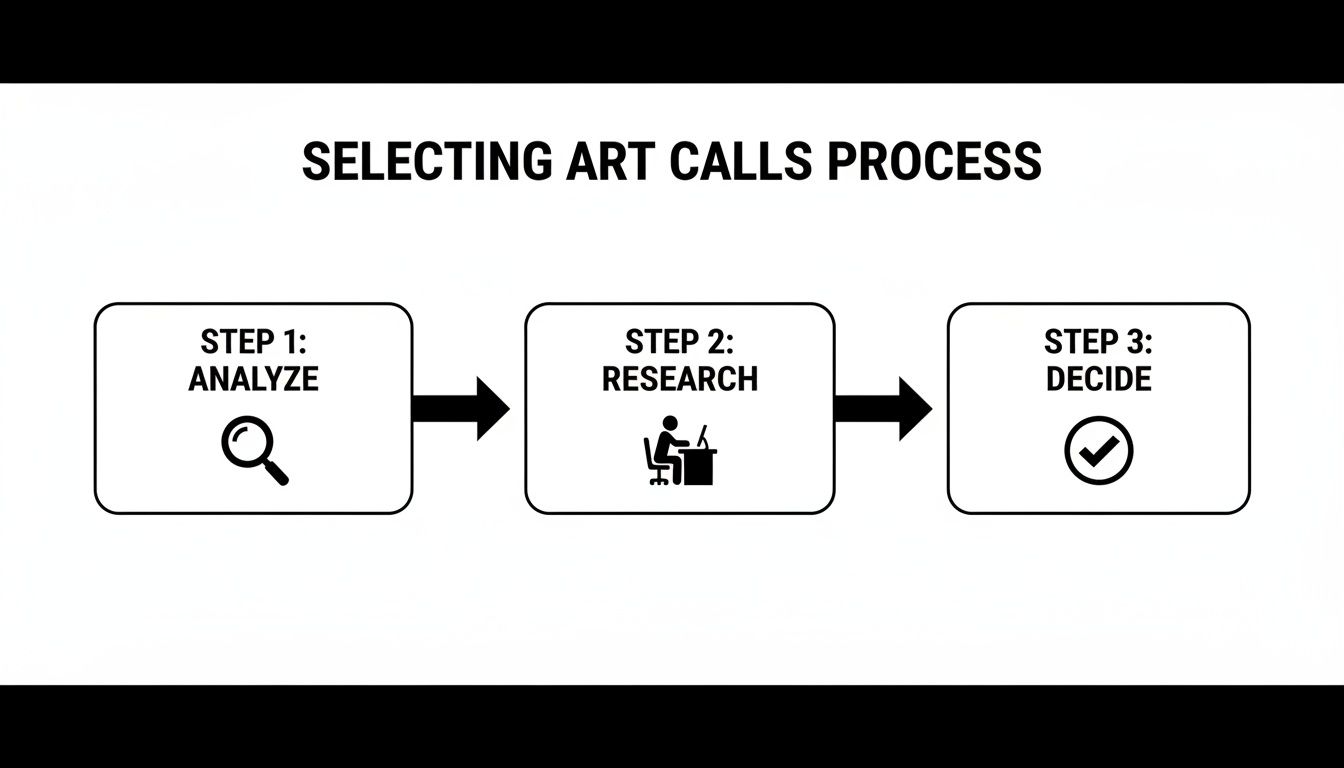
A successful application begins long before you start writing, with careful analysis and research into the opportunity itself.
Perfecting Your Artwork Images
Your images are, without a doubt, the most critical part of your submission. I don't care how stunning your work is in person; poor-quality photographs will fall flat every time. You either need to invest in a professional or learn to take high-quality shots yourself.
Here's what jurors are looking for:
- High Resolution: Images must be crisp and clear. Look for a 300 DPI requirement or whatever is specified.
- Accurate Color: The digital image must be a faithful representation of the original piece. No exceptions.
- Proper Lighting: Use even, diffused light to avoid glares, hotspots, or harsh shadows.
- Clean Background: Crop out everything else. The focus must be entirely on the artwork.
Just as important is following the file naming conventions to the letter. If the prospectus asks for LastName_Title_Year.jpg, do not, under any circumstances, submit IMG_4057.jpg. Disregarding these small instructions creates a nightmare for organizers and makes you look unprofessional.
Competition for high-profile open calls for artists can be fierce. For instance, a recent NYC open call from Apexart received 747 proposals from 79 countries, all reviewed by over 1,000 jurors. With that kind of volume, jurors have to rely on clear, well-prepared applications to make their cuts.
Final Application Review Checklist
Before you hit "submit," run through one last, meticulous check. A simple oversight can undo hours of hard work. This is your chance to catch any little errors.
- Read the Prospectus Again: Go back and double-check every single requirement, from deadlines to image dimensions.
- Proofread All Text: Look for spelling and grammar mistakes in your artist statement, bio, and everything else.
- Verify File Names and Formats: Confirm that your files are named and formatted exactly as requested.
- Check Your Contact Info: Is your email and phone number correct? You’d be surprised how often it's not.
- Confirm Payment: If there's a fee, make sure the payment went through and you have the receipt.
This might feel tedious, but it’s what separates the pros from the amateurs. A polished, error-free submission communicates respect and significantly boosts your chances. To back up your professional presence, jurors often look beyond the application itself, so check out our guide on building effective websites for artists for free.
Managing Deadlines, Fees, and Post-Submission Etiquette
Your work isn't finished the moment you click "submit." In fact, what comes next is what separates serious artists from hobbyists. Mastering the logistics of open calls—from juggling deadlines and budgeting for fees to handling the final outcome with professionalism—is a critical skill. These practical habits will keep you organized, financially smart, and respected in the art world, no matter the result.
Successfully pursuing multiple opportunities at once demands a system. We’ve all been there—the last-minute scramble to get an application in, which almost always leads to rushed work and silly mistakes. A simple calendar, whether it's on your wall or on your screen, is your best defense against that last-minute panic. It allows you to work backward from each due date, giving yourself plenty of breathing room for every step.
This proactive mindset transforms a stressful free-for-all into a controlled, manageable workflow. When you can see your submission schedule laid out, you can properly prioritize and give each application the focused attention it deserves.
Creating Your Submission Calendar
An effective submission calendar is much more than a list of due dates; it's a strategic command center for your career. It’s the tool that lets you track every critical piece of information for each opportunity, ensuring nothing important slips through the cracks when you're managing several applications at once.
For every open call you pursue, your calendar should track these key data points:
- Application Deadline: The final date and time for submission—don't forget to check the time zone.
- Notification Date: When organizers expect to announce their decisions.
- Artwork Drop-off/Shipping Deadline: If you're accepted, this is your window to get the work to the venue.
- Exhibition Dates: The full run of the show, from the opening reception to the final day.
- Artwork Pick-up/Return Date: The period for retrieving your work after the show closes.
Keeping these dates in one place helps you spot and avoid scheduling conflicts, like accidentally committing the same piece to two different shows with overlapping timelines. This kind of foresight is the hallmark of a true professional. For more ways to stay on top of your studio practice, you might explore a dedicated app for artists built to manage inventory and submissions.
A Strategic Approach to Entry Fees
Entry fees can feel like a major roadblock, but it's helpful to reframe them as strategic investments rather than simple costs. Most reputable organizations use these fees to cover real administrative expenses and, importantly, to pay jurors for their expertise. This often results in higher-quality exhibitions and a more serious, focused pool of applicants. The trick is to be discerning.
Not every paid opportunity is worth your money. Before you pay, take a moment to weigh the potential return on that investment. What's the prize money? How prestigious is the venue or the organization? Who are the jurors, and what is their reputation? What are the real chances for sales or catching the eye of a gallerist?
A $35 fee for a chance to get your work in front of a major museum curator could be a brilliant career move. On the other hand, a $50 fee for an unknown online gallery with no history is probably a pass.
Treat your submission budget like any other business expense. Allocate a set amount per quarter for entry fees and stick to it. This forces you to be selective and invest only in the calls that genuinely align with your long-term career goals.
Post-Submission Etiquette: Handling Acceptance and Rejection
The waiting period after you submit requires patience and a thick skin. Whether you receive a "yes" or a "no," how you respond says a lot about you as a professional. The art world is smaller than you think, and your reputation for being gracious and easy to work with will absolutely precede you.
If your work is accepted—congratulations! Respond to the good news promptly and with genuine enthusiasm. Make sure you carefully read any contracts or agreements they send over, paying close attention to the fine print on insurance, shipping logistics, and sales commissions. Your job now is to maintain clear and timely communication with the organizers through the entire process, from shipping the art to picking it up.
Rejection is disappointing, but it's an unavoidable—and frequent—part of the process. It's almost never personal. A juror may have been working toward a very specific curatorial vision, or another artist's piece just happened to be a slightly better fit for the theme. The best thing you can do is move on gracefully. Never fire off an angry email or publicly question a jury’s decision. Instead, file it away as a data point and put your energy into the next great opportunity.
A Few Common Questions About Artist Open Calls
When you're starting out with open calls, or even if you've been at it for a while, a few questions tend to pop up again and again. Getting clear on these points can save you a lot of time and second-guessing, letting you focus on what really matters: putting together a killer application.
Think of this as a quick chat about the unwritten rules and practical realities of the submission process. Let’s clear up some of the most frequent uncertainties artists face.
How Many Open Calls Should I Really Be Applying To?
This is a classic question, but there’s no magic number. The goal is quality over quantity, always. A good, sustainable rhythm for most working artists is aiming for 3-5 highly targeted applications a month.
Why so few? Because that pace gives you enough breathing room to actually read the prospectus carefully and tailor your materials for each specific opportunity. You want to make sure your work is a genuinely great fit for the theme, the venue, and the jurors. Sending out a handful of thoughtful, well-prepared applications is far more effective than blasting out dozens of generic ones and hoping something sticks.
"Your submissions are not reviewed in a vacuum. Jurors often look at the wider catalog of each artist. For me, it’s important to see an artist’s foundation to know a strong submission isn't a lucky fluke."
That little piece of advice says it all. Each application is a reflection of your professional practice, so make every single one count.
Are Open Calls With Entry Fees a Scam or Worth It?
Entry fees can be a sticking point, but they aren't automatically a red flag. In many cases, reputable organizations use those fees to cover real costs, like paying the jurors, funding prize money, or handling administrative work. An entry fee can also act as a filter, ensuring the applicant pool is serious about the opportunity.
The key is to weigh the cost against the potential return. Before you pay, ask yourself a few questions:
- What's the prize? Is the award money, exhibition prestige, or potential for sales compelling enough to justify the fee?
- Who is the organizer? Does the gallery or institution have a solid reputation for putting on high-quality shows and treating artists well? A quick search can tell you a lot.
- Who is on the jury? Is this a chance to get your work in front of influential curators, critics, or gallerists who could open doors for you down the road?
Be wary of high fees from an organization you've never heard of that offers a vague or unimpressive prize. On the flip side, while free calls are great, just remember they often attract a massive number of applicants, making the competition incredibly stiff.
What's the Single Biggest Mistake Artists Make?
Honestly, it’s surprisingly simple: not following the directions. It’s the most common and easily avoidable error I see. Jurors are often sifting through hundreds, sometimes thousands, of applications on a tight deadline.
If you name your image files incorrectly, go over the word count on your artist statement, or submit work that completely ignores the theme, you're giving them an easy reason to set your application aside. Those rules aren't there to be difficult; they’re designed to make a massive administrative task manageable. Read the prospectus twice. Then read it again. Make a checklist. It’s a small step that dramatically increases the odds of your work actually being seen.
Can I Submit the Same Piece to Multiple Calls at Once?
For the most part, yes. You can absolutely submit the same artwork to different open calls simultaneously. The important thing is to read the fine print for each one. Some shows, especially those focused on sales, might require a period of exclusivity if your work is accepted.
The real headache comes if a piece gets accepted into two different physical exhibitions with overlapping dates. The best way to avoid this logistical nightmare is to keep a simple spreadsheet. Track what you've submitted where and note the notification dates. If a piece is accepted and you commit to the show, it's your professional responsibility to immediately withdraw it from consideration for any other opportunities that would create a conflict.