How to Develop Your Art Style a Practical Guide for Painters
That unique art style you've been chasing isn't some far-off destination. Think of it more as a happy accident—the natural result of consistently showing up, staying curious, and trusting your own point of view. The secret is to simply focus on the process of making art itself, rather than stressing about achieving a certain "look." Your authentic voice will find its way out, I promise.
Your Artistic Voice Is Closer Than You Think
So many artists get hung up on the idea that finding a personal style is this huge, mystical event, like a lightning bolt of inspiration that will define their work forever. The reality? It’s far more practical and grounded than that.
An artistic voice isn't found; it's built, one brushstroke at a time. It’s the sum of your technical skills, your unique way of seeing the world, and the subjects that you just can't stop thinking about.
This guide is designed to give you a real, actionable framework for that journey of discovery. Forget the pressure to be "original" overnight. We're going to focus on the foundational habits and intentional exercises that let your style surface on its own terms.
I often compare an art style to your handwriting. You didn't just wake up with it one day. It developed over years of practice and was shaped by teachers and friends, but eventually, it became uniquely yours. No two signatures are identical because no two life stories are identical. It’s the same with your art.
Your style will always be a reflection of:
- Your Influences: The artists, movements, and aesthetics you can't get enough of.
- Your Technique: The specific way you hold a brush, mix your colors, and build layers on a canvas.
- Your Narrative: The stories, feelings, and ideas you feel an undeniable urge to express.
- Your Decisions: The thousands of tiny choices you make every single time you create something.
Obsessing over finding an "art style" can be the biggest distraction from the actual work: just making art. Your style is what's left behind after you've shown up consistently, learned your craft, and paid attention to what truly lights you up. It’s the residue of your journey.
The Foundation of Authentic Expression
The road to developing your art style is paved with consistent effort, not some desperate search for originality. It's about building such a strong technical foundation that your tools—whether acrylics, watercolors, or pencils—feel like a natural extension of your hands.
When you're no longer wrestling with how to paint something, you're finally free to explore why you're painting it.
This is where your real voice starts to emerge. For example, spending time exploring different impressionistic painting techniques might show you that you have a real love for capturing light and movement in a certain way.
As you work through these kinds of exercises, you'll start to notice patterns. Maybe you gravitate toward a specific color palette, a recurring subject, or a type of brushwork that just feels right. These preferences are the very building blocks of your style, and this guide will help you start recognizing and refining them.
Build Skill and Confidence with Consistent Practice
A signature style isn't just an aesthetic choice; it’s the confident mark of technical mastery. This is the kind of confidence that lets your vision flow freely, turning the tools in your hand into a seamless extension of your imagination. To truly find your artistic voice, you first have to build a solid foundation of skill through dedicated, consistent practice.
This isn't about joyless, rigid repetition. It’s about internalizing the fundamentals of your craft so deeply they become second nature. When you no longer have to consciously puzzle over color theory, composition, or how to handle your materials, you free up incredible amounts of creative energy to focus on what you actually want to say with your art.
Establish a Sustainable Practice Routine
Consistency is always more powerful than intensity. The real goal is to weave a sustainable creative habit into your life, not to rely on sporadic, marathon painting sessions that just lead to burnout. Believe me, 15-30 minutes of focused practice each day will get you much further than a single four-hour session once a month.
Start with small, achievable goals. Maybe this week's focus is simply mixing colors or filling a sketchbook page with quick gesture drawings. The key is to build momentum and make the act of creating a non-negotiable part of your daily rhythm.
If you’re just getting comfortable with a new medium, like acrylics, focusing on these foundational skills is even more critical. Getting that initial confidence with your materials is everything. For a helping hand, you might find our guide on how to start painting with acrylics useful.
Incorporate Focused Skill-Building Exercises
Integrating targeted exercises into your routine can dramatically accelerate your technical growth. These drills let you isolate and strengthen specific weaknesses without the pressure of creating a finished masterpiece.
Try mixing some of these into your practice time:
- Timed Gesture Studies: Set a timer for 30-60 seconds and capture the essential movement and energy of a subject. This is fantastic training for your hand and eye, forcing you to see dynamic forms instead of getting lost in tiny details.
- Value Studies: Using only grayscale, paint a simple object or scene. This exercise is the best way to train your brain to see and understand light and shadow—the absolute cornerstone of creating depth.
- Single-Object Studies: Pick one simple thing—an apple, a coffee mug—and paint it over and over from different angles and in various lighting. This deepens your observational skills like nothing else.
The real purpose of consistent practice is to build "visual mileage" that informs your intuition. Every study, sketch, and exercise contributes to a vast internal library of shapes, colors, and compositions that you can draw upon instinctively.
The impact of this consistency can’t be overstated. It’s been shown that artists who commit to regular practice, such as 1,000 hours per year, can crystallize their personal styles up to 50% faster. This dedication is what builds careers. While high-end auction sales have seen dips, smaller art dealers experienced a 17% surge, which points to the power of artists who regularly produce and share new work.
Think about it: Picasso’s Cubism evolved over years of relentless work. Today, it’s estimated that 70% of successful painters still maintain sketchbooks for daily skill refinement. You can dig into more data on the trends shaping the global art market on myartbroker.com.
Ultimately, building this foundation is an act of empowerment. Every practice session, no matter how brief, dismantles technical barriers and replaces them with confidence. It’s how you get to the point where the unique story inside you can finally take center stage.
Discovering Your Voice Through Play and Experimentation
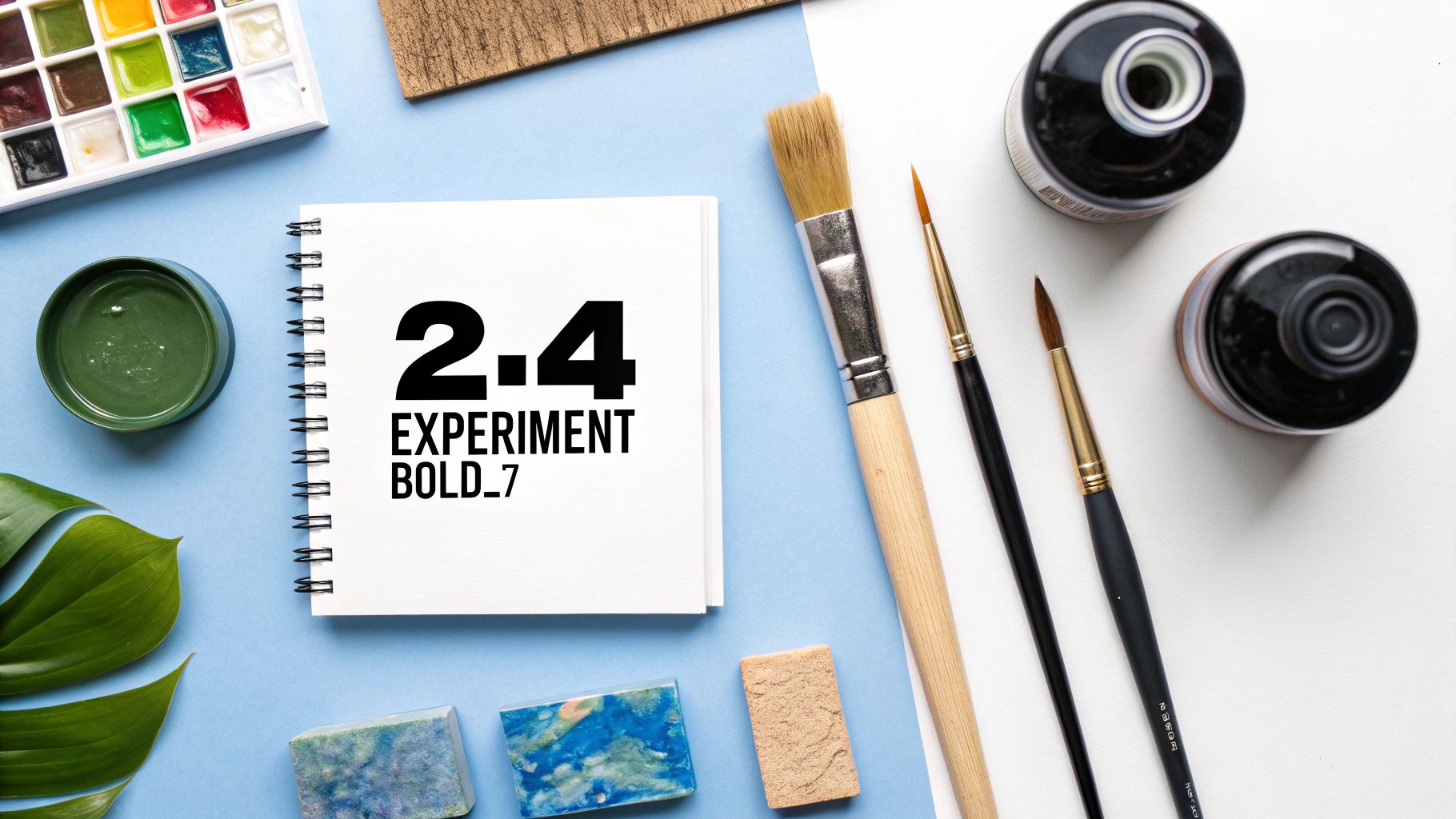
An artist’s unique style often emerges from the quiet, unjudged moments in the studio—the choices you make when you think no one is looking. This is your official permission slip to play, to explore, and to gently push the boundaries of what you think your art is supposed to be. To truly understand how to develop your art style, you have to gather clues about what excites you, and that only happens through intentional experimentation.
This isn't about making a masterpiece. It's about asking "what if?" and having the courage to see what happens.
Embrace Creative Constraints
Sometimes the greatest creative breakthroughs come from working within tight limits. Imposing constraints forces you to solve problems in new ways, often revealing preferences you never knew you had. It's a fantastic, low-pressure way to jolt yourself out of a rut.
Consider trying one of these powerful limitations:
- Limited Palettes: Challenge yourself to create a painting using only three or four colors plus white. This simple rule turns you into an expert at mixing shades and understanding color harmony. You might find an unexpected love for muted, earthy tones or a vibrant, high-contrast look that becomes your signature.
- Unconventional Tools: Put your favorite brushes away for a week. Instead, try painting with a palette knife, a scrap of cardboard, a sponge, or even your fingers. Each tool leaves behind distinct textures and marks, building a new visual vocabulary you can pull from later.
- Time Limits: Set a timer for just 15 minutes and aim to complete a small painting from start to finish. This exercise is brilliant for silencing your inner critic and encouraging you to make bold, intuitive decisions.
Intentional play is serious work for an artist. The discoveries you make with a limited palette or a new tool are the foundational data points that will eventually build a style that is authentically yours.
The following exercises are designed to push you just outside your comfort zone, helping you gather those crucial data points on what truly resonates with your artistic sensibilities.
Guided Experimentation Exercises for Painters
| Exercise Focus | Objective | Acrylic Suggestion | Watercolor Suggestion |
|---|---|---|---|
| Texture Building | To explore tactile surfaces and create physical depth. | Mix sand, coffee grounds, or modeling paste into your paint. Apply with a palette knife. | Use a salt-on-wet-wash technique or lift color with a crumpled paper towel. |
| Mark Making | To expand your visual vocabulary beyond standard brushstrokes. | Use the hard edge of a credit card to scrape paint across the surface. Try stamping with found objects. | Experiment with a dry brush technique for scumbling. Use a bamboo pen for fine, scratchy ink lines. |
| Color Dominance | To understand the emotional impact of a single-hue focus. | Create a monochromatic piece using only shades and tints of a single color, like Ultramarine Blue. | Build up a painting with transparent layers of a single color (e.g., Quinacridone Gold) to explore its full value range. |
| Compositional Risk | To break free from conventional composition rules. | Place your main subject directly in the center or pushed to the very edge of the canvas. | Use negative painting techniques to define your subject by painting the space around it. |
Remember, the goal of these exercises is discovery, not perfection. Pay close attention to what feels exciting and what feels frustrating—both are telling you something important.
Mix Your Mediums
Stepping outside your primary medium is one of the fastest ways to accelerate your growth. The insights you gain from one practice almost always inform another. If you're an acrylic painter, introducing water-soluble pastels or collage elements can lead to unexpected textural combinations. For watercolorists, incorporating ink or gouache can bring new levels of definition and opacity to your work.
This cross-pollination of techniques isn't just creatively fulfilling; it's also a smart move in today's art world. Artists who show proficiency in five or more mediums can see an originality boost of up to 35%, according to creativity studies. This novelty is highly valued, particularly as the global wall art market—with key players like the U.S. (42% share) and China (19% share)—favors diverse and restorative art. You can find more data on trends in the wall art market from Fortune Business Insights.
Track Your Artistic Responses
As you experiment, the most crucial step is to pay attention to your own reactions. The goal is to identify what feels right, not just what looks good. This is a process of tuning into your artistic intuition. Keep a sketchbook or journal nearby to jot down your findings.
After each session, ask yourself a few questions:
- Which exercise felt the most engaging and joyful? Why?
- What happy accidents happened, and how might I replicate them on purpose?
- Did a specific color combination or texture excite me more than others?
- What felt awkward or frustrating, and what does that teach me?
This isn't about judging the final product; it's about collecting clues. Maybe your limited palette experiments reveal a consistent pull toward a certain color family. If you need a refresher on getting the most from your paints, our guide on how to mix acrylic paint colors can be a great resource.
By consistently trying new things and observing your responses, you are actively steering your own artistic development. Every experiment, whether it "succeeds" or not, provides valuable information. It brings you one step closer to a visual language that feels less like a choice and more like a natural extension of who you are.
Find the Core Themes in Your Work
A compelling art style goes far beyond a consistent look—it's your point of view. It’s the story you choose to tell about the world using your unique visual language. While technical skill gives you the "how," your thematic focus provides the crucial "why." This is what gives your work depth, meaning, and a voice that is instantly recognizable as your own.
When you start to identify the recurring subjects, emotions, and ideas you're naturally drawn to, you create a powerful thread that unifies your entire body of work. This is the shift that takes your paintings from being individual pieces to a cohesive and resonant collection.
Look Inward to Discover Your Narrative
Often, your core themes are hiding in plain sight, embedded in the choices you subconsciously make every time you pick up a brush. The first step is to become an observer of your own creative process. Step back and look at everything you've made—the finished pieces, the abandoned sketches, the quick studies—as if you were a curator putting together an exhibition.
What patterns jump out at you? Are you constantly painting solitary figures, turbulent seascapes, or quiet domestic scenes? Do certain moods or emotions, like melancholy or wonder, appear again and again?
This kind of self-reflection is essential for anyone figuring out how to develop your art style. Your style isn't just your brushwork; it is the story you are compelled to tell.
A thematic focus transforms your art from a series of technical exercises into a meaningful conversation. It’s the difference between a pretty picture and a piece that stays with a viewer long after they’ve looked away.
Journaling Prompts for Thematic Discovery
To dig deeper, set aside some time for journaling. Writing is a surprisingly powerful tool for clarifying your thoughts and uncovering the "why" behind your creative impulses. There are no right or wrong answers here; the only goal is to explore your internal world.
Try these prompts to guide your reflection:
- What stories from my life feel unresolved or important? Think about formative memories, personal challenges, or moments of pure joy that have shaped who you are.
- What emotions am I most interested in exploring? Consider feelings like nostalgia, solitude, resilience, or awe. For a deeper dive, check out our thoughts on creating art that expresses emotion.
- If I could only paint three subjects for the rest of my life, what would they be? This constraint can be incredibly revealing, forcing you to pinpoint your most deeply held interests.
- What message or feeling do I want to leave with my viewer? Think about the impact you want your work to have on someone else.
This introspective work is what builds the narrative foundation of your style. It ensures your art is not just visually appealing but also emotionally and intellectually resonant.
Connect Your Themes to Your Technique
Once you have a clearer sense of your core themes, you can start to intentionally align your technical choices to support them. Your palette, brushwork, and composition should all serve the story you are telling. This alignment is where a truly authentic style is born.
For example, if your theme is the chaotic energy of the ocean, you might choose:
- A dynamic, cool-toned palette with deep blues, greens, and stormy grays.
- Thick, energetic brushstrokes made with a palette knife to convey movement and power.
- Asymmetrical compositions that create a sense of unease or unpredictability.
On the other hand, if your theme is the quiet solitude of nature, your choices might look very different:
- A muted, earthy palette with soft greens, warm ochres, and gentle lilacs.
- Soft, blended brushwork that creates a dreamlike, atmospheric quality.
- Centered, stable compositions that evoke a sense of peace and calm.
This intentional connection between your "why" (theme) and your "how" (technique) is what creates a powerful, cohesive body of work that feels undeniably yours. It’s a process with real-world impact for artists, too.
Developing a unique style rooted in personal storytelling is increasingly valued in the art market. As collectors seek out more genuine voices, even smaller galleries with turnovers under $250,000 saw a 17% sales increase, showing that heartfelt, personal work resonates. In the US market, which accounts for 42% of global sales, there's a high appeal for inclusive, nature-themed art. A strong narrative for each piece can even boost engagement by 25% in online sales. You can explore more in the Art Basel and UBS Global Art Market Report on artbasel.com.
By pinpointing your thematic focus, you aren’t just refining your style; you are building a stronger, more meaningful connection with your audience and solidifying your place in the creative world.
Refine and Share Your Evolving Style
Developing a personal art style is never a one-and-done deal. It’s a living, breathing process—a constant cycle of creating, stepping back to reflect, and then thoughtfully tweaking your approach. As your technical skills improve and your core themes become clearer, the real work begins: learning to look at your own art with a critical, objective eye.
This isn't about deciding if a painting is "good" or "bad." It's about dissecting your work to understand why certain parts sing and where you can push yourself further. This active, ongoing refinement is what transforms a random collection of paintings into a cohesive, compelling body of work.
Mastering the Art of Self-Critique
To really get anywhere, you need a system for critiquing your own paintings. When you finish a piece, don't judge it right away. Set it aside for a day or two. That little bit of distance gives you the emotional space to see it clearly, without the fresh frustration or excitement clouding your judgment.
When you come back to it, swap broad questions for specific ones. Instead of asking "Do I like this?" get analytical.
- Composition: Where does my eye land first? Where does it go next? Did I intend for that to happen?
- Color Harmony: Does this palette actually create the mood I was aiming for, or is it fighting it?
- Value Structure: Is there enough contrast? Can you clearly see a range of lights and darks that gives the piece depth and form?
- Brushwork: Do the marks I made feel energetic, calm, or chaotic? Does that energy match my subject? If you're looking to expand your toolkit here, our guide on how to create texture in paintings has some great hands-on techniques.
By asking these kinds of targeted questions, critique stops feeling like a personal judgment and starts becoming a powerful tool for growth. You’ll pinpoint exactly what to focus on for your next piece.
Seeking and Processing Constructive Feedback
Looking at your own art will only get you so far. We all have blind spots, and a fresh perspective from a trusted source can be invaluable. The key is to be selective. Seek out feedback from fellow artists or mentors whose work you admire and who you know can give you more than just a simple "I like it."
When you ask for their opinion, guide the conversation. A generic "What do you think?" often leads to a generic answer. Try something specific, like, "I feel like the background is a bit flat. Do you see a way I could push the color harmony to create more depth?" This gives them a clear problem to solve and ensures you get actionable advice.
When someone is giving you feedback, your job is to listen, not to defend your work. The goal is to understand how someone else sees it. Afterward, you can filter their advice through your own artistic vision—keep what resonates and feel free to discard the rest.
From Studio to Audience: Presenting Your Work
Sharing your art is where the creative cycle comes full circle. It's the bridge between your private studio practice and the public. The way you present your paintings shapes their story and solidifies your identity as an artist.
Photographing Your Artwork
This is non-negotiable. Bad photos will completely misrepresent the color, texture, and impact of your work.
- Light it Right: Use soft, natural light. An overcast day next to a large window is perfect.
- Keep it Straight: Make sure your camera is perfectly parallel to the artwork. Any angle will cause distortion.
- Edit with a Light Touch: Your only goal in editing is to make the photo look exactly like the original painting. Adjust brightness, contrast, and white balance until it’s a perfect match.
Crafting Your Artist Statement
An artist statement is a short, first-person explanation of your "why." It gives your audience context, touching on your themes, your process, and what inspires you. Keep the language clear and direct—avoid art-school jargon that no one understands.
The process below offers a simple framework for identifying the core ideas that will become the foundation of your artist statement.
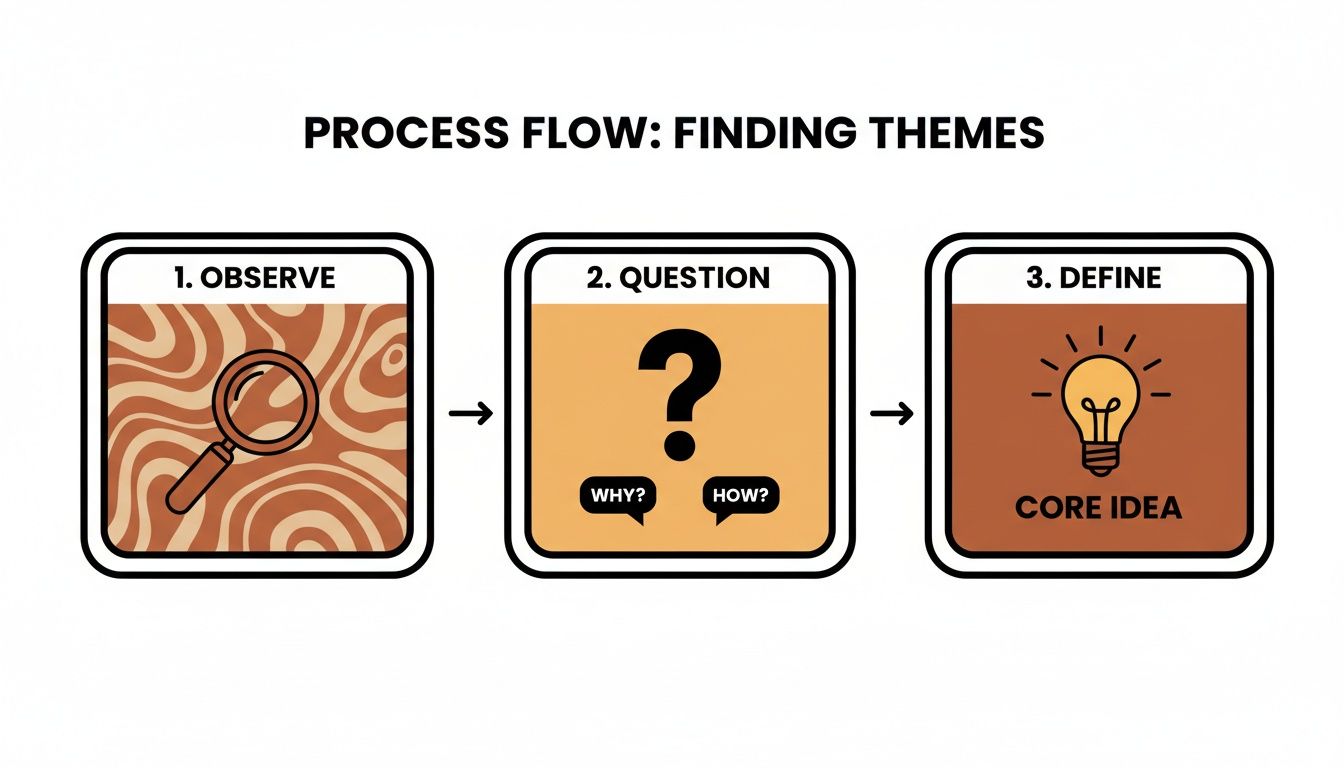
This progression helps you move from general observation to a clear, defined statement about what drives you to create.
Curating a Cohesive Portfolio
Whether it’s on a website, a PDF, or an Instagram feed, your portfolio needs to tell a story. Choose your 10-15 strongest pieces that best represent where your style is right now. Arrange them thoughtfully to show the connections between them, highlighting the consistent artistic voice that runs through your work. This curated collection is the ultimate statement of your style, presented with confidence.
Your Questions Answered: Navigating the Path to Your Art Style
The journey to find your own artistic voice is rarely a straight line. It's winding, full of questions, and sometimes feels like you're walking in circles. That's completely normal. Having these questions is a sign you're engaged in the process and ready to dig deeper.
Let's tackle some of the most common hurdles and uncertainties artists face. Think of this as a conversation with a fellow creator who's been there, offering some clarity for the road ahead.
How Long Does It Take to Develop a Unique Art Style?
Honestly, there’s no magic number. For most artists, a truly distinct voice starts to take shape after several years of consistent, dedicated practice. It's a marathon, not a sprint. The real secret isn't speed; it's persistence.
Instead of watching the clock, pour your energy into the daily act of making art. Focus on learning from your experiments and exploring what genuinely pulls you in. Your style will emerge organically as your skills sharpen and your personal vision comes into focus. Let go of the pressure to arrive at a destination and learn to love the process of discovery itself.
Your art style isn't a finish line you cross. It's the unique footprint you leave behind on your artistic journey—the more you create, the clearer it becomes.
Is It Okay if My Art Style Keeps Changing?
Absolutely. In fact, you should be concerned if it doesn't change. A shifting style is a sign of a healthy, growing artist. Just look at masters like Monet or Picasso. Their careers are defined by distinct periods where their work evolved dramatically as they absorbed new ideas, techniques, and life experiences. Your art should be a living thing, reflecting your own growth.
Forcing yourself into one box because you think you should be consistent is a recipe for creative burnout. The real consistency in your body of work won't come from a static look, but from your unique perspective, your recurring interests, and the personal touch that only you can bring. That core voice will shine through, even as your visual language changes. Embrace the evolution—it means you're alive and pushing forward.
How Do I Avoid Just Copying My Favorite Artists?
Learning from artists you admire is crucial, but the trick is to move from imitation to integration. Instead of trying to replicate an entire painting, get surgical. Ask yourself what specifically you love about their work.
- Is it the way they use a limited, moody color palette to create atmosphere?
- Is it their energetic, almost sculptural brushwork that makes a simple object feel alive?
- Perhaps it's their daring compositions that break all the traditional rules?
Once you pinpoint that one element, isolate it. Try applying just their approach to color to your own subject matter. Or borrow their brushwork technique to paint something they would never touch. By combining specific ideas from several influences with your own themes, you synthesize something completely new. You aren't making a copy; you're adding a powerful new tool to your creative arsenal, one you learned from a master.
What Should I Do When I Feel Stuck or Uninspired?
First, know that feeling stuck is part of the deal. Every artist faces it. See it not as a personal failure, but as a signal to change things up and take the pressure off. Trying to force creativity when the well is dry is the worst thing you can do. Instead, give yourself permission to play.
Grab a medium you never use—charcoal, oil pastels, even a simple digital art app—and just make a mess with zero expectations. Spend an afternoon at a park or coffee shop filling a sketchbook with quick, observational drawings, focusing only on capturing what you see in the moment. Sometimes, the best antidote is to simply look back at your old work. Seeing how far you've already come can be an incredible motivator. Inspiration has a funny way of showing up when you stop hunting for it and just get curious again.
At Skyler’s Art, every painting represents a moment on a continuous journey of expression and discovery. If you're looking for art that tells a story and connects on a deeper level, I invite you to explore the gallery of original works.
Find a piece that speaks to you at https://skylers-art.org.