Your Guide to Landing Artist Assistant Jobs
For anyone looking to break into the professional art world, becoming an artist assistant is one of the most direct and rewarding paths you can take. It’s a role that’s part hands-on studio work, part critical administrative support, and it offers an unparalleled, behind-the-scenes education.
Understanding the Modern Artist Assistant
Before you even start looking at listings, you need to get one thing straight: the romanticized image of an assistant just mixing paints or tidying up brushes is a thing of the past. The modern artist assistant is often the central hub of the entire studio operation, a true partner in the artist's practice.
You’re stepping into a dynamic environment where your responsibilities can change on a dime, shifting from creative problem-solving one hour to logistical management the next. Adaptability isn't just a buzzword here—it's a core requirement.
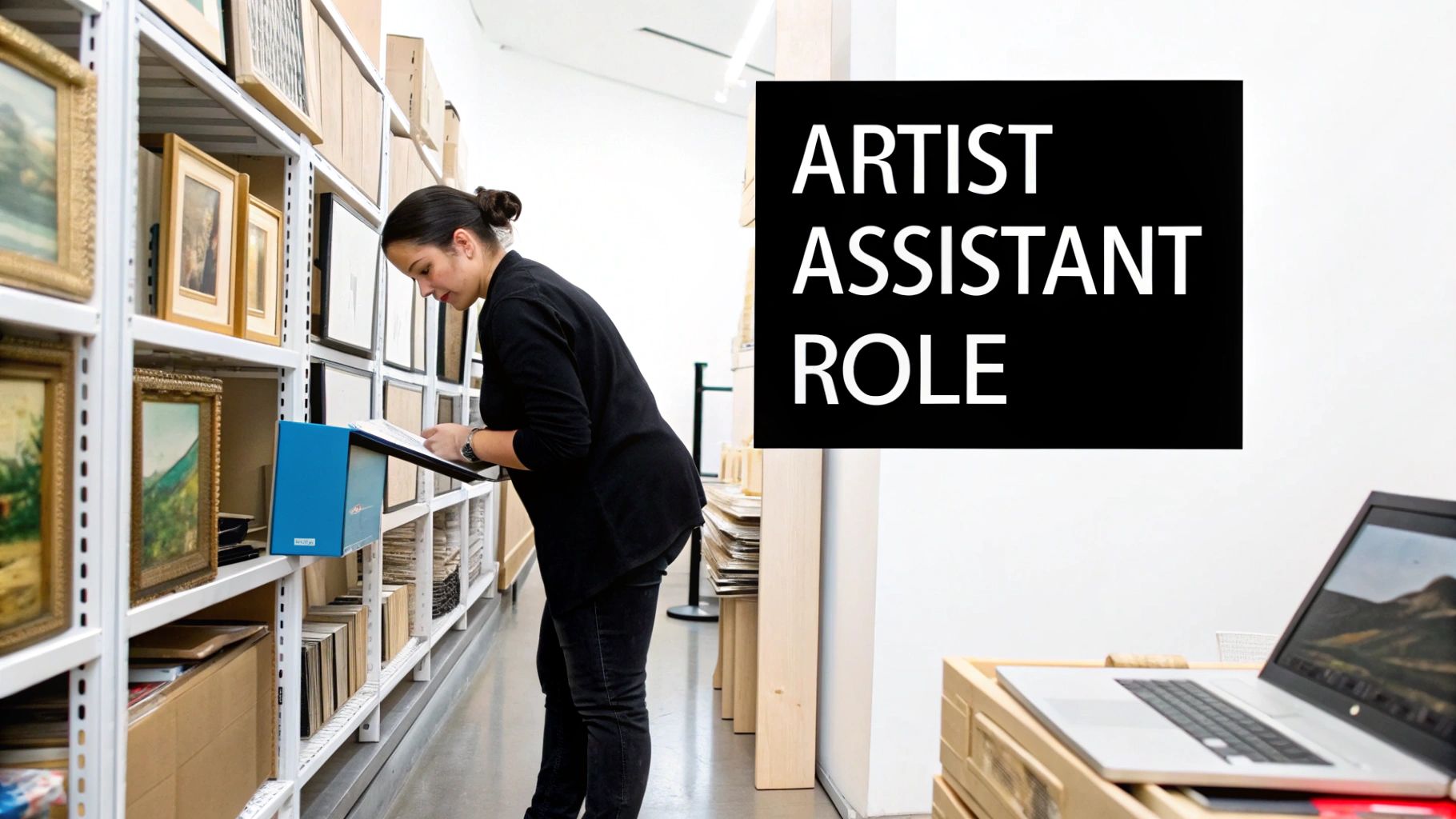
Beyond the Studio Floor
Yes, you'll likely get your hands dirty, but a huge portion of the job happens away from the easel or the clay. You could be managing the artist’s jam-packed calendar, coordinating the complex shipping logistics for a show in another country, or even running the artist's website and social media presence. These aren't just side tasks; they are the essential functions that keep a professional studio afloat.
Communication is another massive piece of the puzzle. You’ll often be the first person a gallery, a collector, or a journalist speaks to. That means your professionalism and discretion are constantly on display. How you represent the studio is just as vital as your skill with a specific tool or software.
Identifying Your Ideal Role
Not all artist assistant jobs are cut from the same cloth. The day-to-day reality of the role is shaped entirely by the artist you work for—their medium, the stage of their career, and their individual workflow. An emerging artist might need a jack-of-all-trades, while a highly established artist with a massive output might hire several assistants with very specific, siloed roles.
To help you narrow down your search, it helps to know where your own strengths and interests lie. Most assistant roles fall into a few general categories, even if the job description asks you to wear multiple hats.
Common Types of Artist Assistant Roles
Understanding the different specializations can help you pinpoint which opportunities are the best fit for your skills and long-term career goals. Here's a quick breakdown of the most common roles you'll encounter.
| Role Type | Primary Focus | Common Daily Tasks |
|---|---|---|
| The Fabricator | Hands-on art production | Stretching canvases, welding, mold-making, running print editions, photo/video editing. |
| The Archivist | Organization & documentation | Cataloging artwork in a database, photographing new work, managing digital files, maintaining archives. |
| The Administrator | Business & logistics management | Answering emails, scheduling meetings, ordering supplies, coordinating shipping, light bookkeeping. |
| The Communicator | External relations & marketing | Updating the website, managing social media, drafting newsletters, liaising with galleries and press. |
Knowing where you fit in this landscape is the first step. For instance, if you're drawn to the archivist path, coming in with knowledge of the best app for artists for inventory management can immediately set you apart.
By figuring out which of these roles genuinely excites you, you can stop being a general applicant and start being a targeted, compelling candidate. It shows the artist you don't just want a job—you understand their specific needs and see exactly how you can contribute to their practice.
Building a Standout Skillset and Portfolio
A deep love for art is the starting point, but it won't get you the job. To land a competitive artist assistant role, you need to prove you can be a genuine asset in a professional studio environment. It’s about more than just appreciating the final product; it's about understanding and contributing to the process.
Your real value to an artist is your ability to solve problems, anticipate needs, and free up their time to create. Start thinking like a studio manager. What are the time-consuming, administrative, or technical tasks that pull an artist away from their core work? That's where you come in.

Cultivating Essential Hard Skills
Hard skills are the concrete, teachable abilities that form the backbone of your resume. These are the things you can prove you know how to do, often in a hands-on working interview.
Begin by looking at the artists you admire. If you’re drawn to painters, learn to stretch a canvas flawlessly, mix colors with precision, and varnish a piece without a single imperfection. If sculpture is your interest, get your hands dirty with mold-making, casting, or even basic welding.
Digital competence is no longer optional—it's essential. Modern art practices are run like small businesses, and technology is at the center of it all.
- Adobe Creative Suite: An artist's studio lives on Photoshop, InDesign, and Illustrator. These tools are used for everything from documenting work to mocking up exhibition layouts and creating professional proposals.
- Video Editing Software: As artists increasingly use video to document their process or create digital works, basic skills in Premiere Pro or Final Cut Pro will make you stand out.
- Project Management Tools: Knowing your way around platforms like Asana or Trello shows you can track complex projects and keep the studio on schedule.
And don't underestimate the importance of practical logistics. Knowing how to professionally pack, crate, and ship artwork is a hugely valuable skill. It's a high-stakes task that requires immense care, and handling it confidently is a massive relief for any artist.
Mastering In-Demand Soft Skills
While your technical skills might get you an interview, your soft skills will get you hired and make you indispensable. These are the interpersonal qualities that determine how you function as part of a small, often high-pressure team.
Impeccable organization is at the top of the list. Studios can be chaotic, and your ability to create order—whether it’s by developing a new inventory system for supplies or meticulously managing a digital archive—is priceless. This feeds directly into proactive problem-solving. Don’t just point out that a tool is broken; research the replacement and come with a solution.
Clear, professional communication is also non-negotiable. You’ll likely be a point of contact for galleries, collectors, foundries, and suppliers. Representing the artist with poise and clarity is a core part of the job.
The best assistants I’ve ever worked with see what's needed before they're asked. They notice a specific pigment is running low and reorder it before a deadline is jeopardized. That kind of foresight is what separates a good assistant from a truly great one.
Tailoring Your Portfolio and Resume
This is where many aspiring assistants miss the mark. You need to reframe your application materials completely. Your portfolio shouldn't just be a showcase of your personal art; it needs to be a testament to your technical execution and project management abilities.
- Document Your Process: Instead of just showing a finished painting, include high-quality photos of you stretching the canvas, prepping the surface, or setting up the lighting to photograph it.
- Create a Technical Skills Section: On your resume, be specific. Don't just say you "know paint." List proficiencies like, "Advanced knowledge of oil and acrylic mediums, including gesso preparation and varnishing techniques," or "Expert in archival practices for works on paper."
- Use Project-Based Language: Frame your experience with strong action verbs that show results. Instead of "helped with projects," try "Managed fabrication of a three-part sculpture, from material sourcing and budget tracking to final installation logistics."
Ultimately, your resume and portfolio must answer one simple question for the artist: "How will this person make my life easier and my studio run better?" An effective portfolio doesn't just show what you can make; it demonstrates what you can do. As you pull these materials together, presenting them on a clean, professional website is key; you can find excellent resources for building websites for artists for free to get started.
How to Find Hidden Opportunities in the Art World
While job boards have their place, the truth is that the best artist assistant gigs rarely see the light of day on a public listing. They’re filled quietly, through an informal network built on reputation, trust, and word-of-mouth recommendations.
If you want to land one of these roles, you have to be proactive. It's about combining smart digital searching with genuine, real-world networking. The art world can feel huge, but it's surprisingly small once you're in it. Your success often comes down to who you know—and more importantly, who knows you and your work ethic.
Strategic Online Platforms
You can skip the massive job sites where your application is just one in a thousand. Instead, focus your energy on the niche platforms where artists and art professionals actually look for talent.
- NYFA Classifieds: The New York Foundation for the Arts is the gold standard. It's a trusted resource for serious artist assistant jobs, residencies, and other professional opportunities across the U.S.
- University Art Department Listings: Check the job boards of top BFA and MFA programs. Even if you didn't attend, these are often public and feature high-quality positions posted by alumni and faculty.
- Gallery Websites: Go directly to the source. Look at the "About" or "Contact" pages of galleries representing artists whose work you admire. Sometimes they post openings for their artists right there on the site.
Building Authentic Connections in Person
Being smart online is only half the battle. In the art world, real relationships are still the most valuable currency. That means showing up, being engaged, and making a real connection.
Gallery openings, open studios, and artist talks are your best bet. Don't go in with the goal of asking for a job on the spot—that will almost always backfire. Instead, focus on building a genuine rapport. Introduce yourself to gallery staff, chat with curators, and if the moment feels right, talk to the artists.
A brief, insightful conversation about an artist’s process at their opening is far more memorable than a cold email. People hire individuals they feel a connection with, especially for a role as personal as an assistant.
When you do this consistently, you shift from being just another applicant to being a familiar face in the community. The next time a need arises, your name will be on their short list. A great way to start is by getting involved in local creative hubs. Check out our guide on how to find art collectives near me to find your local scene.
The field itself is growing, which is good news for anyone looking to get in. According to a report from the National Endowment for the Arts, there are about 2.38 million artists with primary jobs in the United States. That growth creates a constant need for skilled assistants, making this role a critical entry point into a professional art career.
Acing Your Application and Interview
A generic application is the fastest way to get your resume tossed. When you're applying to be an artist's assistant, your real goal is to show a genuine, informed interest in that specific artist's practice—not just a need for any job that gets you into a studio. This means every application needs a personal touch that templates just can't provide.
Your cover letter is where you make that first, critical impression. It should read like a direct response to the artist's work. Talk about a specific series that resonated with you, an exhibition of theirs you saw, or a particular technique they use that you find fascinating. This immediately shows you’ve done your homework and are applying with real intention.
Preparing for a Unique Interview Process
The interview for an artist assistant is rarely just a chat across a table. A lot of artists prefer a working interview, which is essentially a paid trial that might last a few hours or even a full day. Think of it as a practical audition.
Be ready to get your hands dirty. You might be asked to jump right in and handle tasks central to their workflow, like:
- Stretching a canvas to exact dimensions.
- Carefully packing a fragile sculpture for shipping.
- Organizing a messy folder in their digital archive.
- Mixing a precise color swatch to match a sample.
The point isn't necessarily perfection, especially on the first try. It’s about showing you're competent, you can follow directions carefully, and you know how to approach a problem. Don't be afraid to ask clarifying questions if you're unsure about a step—it shows you’re more concerned with getting it right than just getting it done.
An artist once told me, "I can teach someone how to sand a sculpture, but I can't teach them how to have a proactive attitude." Your enthusiasm and willingness to learn during a working interview can often make a stronger impression than having flawless technical skills from the get-go.
Answering Situational and Technical Questions
Beyond the hands-on test, expect questions that probe your judgment and reliability. An artist needs to know they can trust you to handle challenges professionally, sometimes without direct supervision.
They might throw a situational question at you, like, "What would you do if a critical art supply didn't arrive on time for a deadline?" They aren't looking for a single right answer; they're testing your thought process.
A strong response demonstrates a calm, proactive mindset. You'd want to outline a clear plan: first, check the tracking and contact the supplier. Simultaneously, research local stores for alternatives. Then, present the artist with a quick, clear summary of the problem and a couple of potential solutions. This shows you can manage a hiccup without creating more stress for them.
Ultimately, your ability to show professionalism, adaptability, and a forward-thinking attitude will make you an indispensable candidate. And if you're looking for more places to practice these application skills, exploring resources like open calls for artists is a great way to find opportunities and hone your approach.
Navigating Contracts, Pay, and Studio Dynamics
Getting the job offer is a great feeling, but it’s really just the beginning. Now, it’s time to talk business. Understanding the financial side of things and how the studio operates is absolutely critical if you want to build a career that’s both sustainable and respectful. This means getting clear on pay, your employment status, and setting professional boundaries right from day one.
When you handle this part of the process like a pro, you're not just taking a job—you're stepping into a professional partnership where your work and your rights are properly recognized.
Understanding Your Compensation
Let's talk money. Pay for artist assistants is all over the map. It really depends on where the artist is in their career, what you'll be doing, and where you live.
In the United States, the average hourly wage hovers around $18.50, which works out to about $38,480 a year. Be warned, though: that number doesn't go very far in major art hubs like New York or Los Angeles. The pay scale is wide, too, stretching from as low as $13 to nearly $40 an hour. For a deeper dive into salary data, a great resource is PayScale.com.
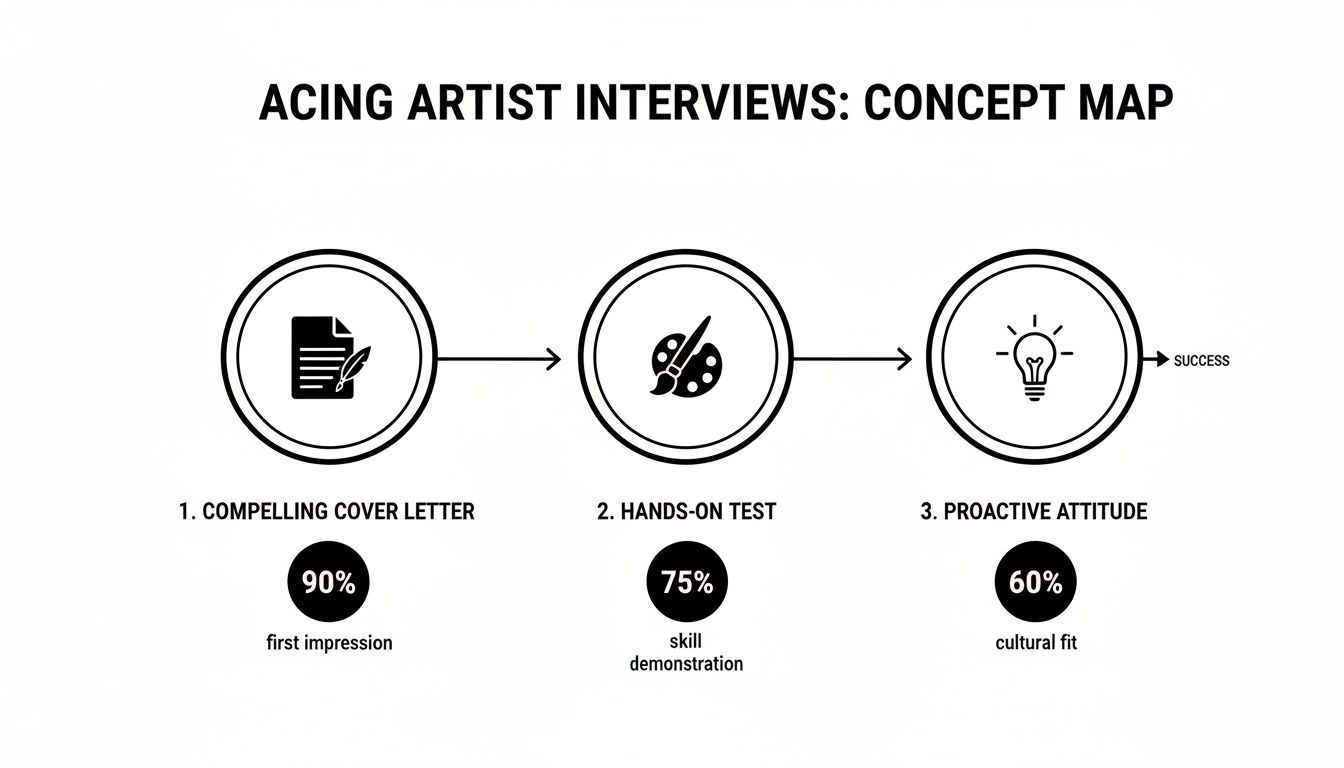
Successfully navigating the interview process puts you in the best position to negotiate a contract and pay that truly reflect your value.
Employee vs. Independent Contractor
This is one of the most important things you need to clarify: are you an employee or an independent contractor? The answer dramatically changes how you’re paid and how you handle taxes.
- Employee (W-2): You're on the studio's payroll. The artist withholds taxes from your paycheck, and you're usually covered by workers' compensation. Your hours and tasks are typically managed directly.
- Independent Contractor (1099): You're essentially self-employed. You get paid in full and are responsible for sorting out your own self-employment taxes. This often comes with more freedom, but you have to be on top of your finances.
You absolutely must get this straightened out before you begin working. It has huge legal and financial consequences down the line.
A clear, written agreement is your best tool for preventing future misunderstandings. It isn't about a lack of trust; it's about establishing a foundation of professional respect and mutual understanding for the working relationship.
Key Elements of a Work Agreement
Forget handshake deals. Whether it’s a formal contract or just a detailed letter of agreement, get everything in writing. A vague verbal understanding is a recipe for disaster and won't protect you or the artist.
Make sure your agreement clearly spells out:
- Scope of Duties: A detailed rundown of everything you'll be responsible for.
- Work Schedule: How many hours you're expected to work each week and any rules on overtime.
- Compensation: The exact rate of pay, when you’ll be paid (e.g., bi-weekly), and how.
- Termination Clause: The conditions for ending the agreement and how much notice is required from either side.
Nailing the business side of an assistant role does more than just pay the bills. It builds a professional reputation that can open up incredible opportunities, like landing one of the coveted artist residencies in Chicago or other creative hubs.
Common Questions About Artist Assistant Jobs
As you start thinking about finding an artist assistant job, you're bound to have questions. It's totally normal. The art world can feel a bit opaque from the outside, and knowing what to expect can give you a huge confidence boost and help you focus your search.
Let's walk through some of the most common questions I hear from people trying to break into these roles. Getting clear on things like education, application mistakes, and career paths will help you put your best foot forward.
Do I Need an Art Degree to Become an Artist Assistant?
This is probably the number one question I get asked, and the short answer is no, not necessarily. While a BFA or MFA certainly doesn't hurt, many artists I know value hands-on, practical skills far more than a diploma.
What really matters is what you can do. Can you stretch a canvas perfectly? Do you know your way around archival photography? Are you a wizard with the Adobe Creative Suite? These are the things that make an artist's life easier. For roles that are more administrative, a background in project management might actually be more valuable than a studio art degree. It’s all about proving you have the specific, tangible skills to help their studio run like a well-oiled machine.
A strong portfolio that showcases your technical craft and a professional attitude are your most valuable assets. You need to show an artist that you can walk in and immediately be a help to their practice, with or without a degree.
What Are the Biggest Mistakes Applicants Make?
By far, the most common mistake is sending out a generic, copy-and-paste application. Artists get a ton of these, and they can spot a form letter from a mile away. When you don't take the time to tailor your cover letter to their specific work, you're basically saying you don't really care about their practice.
Another major misstep is sending a portfolio that’s all about your own artistic vision. Remember, they aren't hiring another artist to collaborate with; they're hiring someone to support their work. Your portfolio should highlight your technical skills—show them your precision, your craft, your ability to execute a task flawlessly.
Finally, a simple lack of professionalism can sink your chances before you even start. Things like responding to emails slowly, showing up late for an interview (even a virtual one!), or clearly not having done your homework on the artist's career are all major red flags.
How Can I Turn an Assistant Job Into a Long-Term Career?
Think of this role as a paid apprenticeship. Your goal should be to become a sponge. Absorb everything you can about the artist’s techniques, their business savvy, and the professional network they’ve built over the years.
When you meet gallerists, curators, or collectors, be present and build genuine relationships. Those connections will be invaluable later on. Don't be afraid to ask for more responsibility either; it shows you're invested and allows you to build new skills.
Most importantly, don't let your own art fall by the wayside. Many artists are incredibly supportive of their assistants' creative ambitions. Use the job to sharpen your skills and expand your network, but always keep your own practice moving forward. This experience can be the perfect launchpad for your own successful career if you play your cards right.
At Skyler’s Art, we believe in the power of art that tells a story. Explore a collection of original paintings that blend impressionistic energy with personal narrative, and find a piece that speaks to you.