What is narrative art: A Beginner’s Guide to Visual Storytelling
Narrative art is, quite simply, art that tells a story. But it’s so much more than a pretty picture. It captures a single, charged moment that powerfully implies a before and an after. Think of it as one frozen frame from a film, packed with enough detail and emotion to ignite your imagination and leave you wondering what happens next.
The Power of a Painted Story
At its core, narrative art turns a static image into a dynamic experience. It doesn’t just present a scene; it invites you to become part of a story. Instead of just looking, you find yourself playing detective, piecing together the visual clues the artist has left behind to uncover the hidden tale.
This is what elevates a painting beyond mere decoration. The goal is to forge a real connection, telling personal, relatable stories that resonate long after you’ve looked away.
From Static Image to Dynamic Experience
So, how does a silent, two-dimensional painting manage to tell a complex story? Artists have a whole toolkit of techniques they use to guide your eye and breathe life into the canvas. They don't just paint a person; they paint a character with a past, a present mood, and an uncertain future.
A narrative work of art is a story told in a single moment. It relies on the viewer's ability to interpret visual cues, connect with the characters' emotions, and imagine the events that occurred before and will happen after the depicted scene.
This process transforms viewing into an active, imaginative exercise. If you're interested in how artists articulate these intentions in their own words, our guide on how to write artist statements offers a closer look.
Core Components of a Visual Story
Artists skillfully combine several key elements to build a complete story within a single frame. When you learn to spot these components, you can "read" a painting and truly appreciate the artist's craft. Each piece of the puzzle works together to build a narrative you can feel as much as see.
Here's a quick breakdown of these fundamental elements.
Core Components of Narrative Art at a Glance
| Element | Function in Storytelling |
|---|---|
| Subject & Characters | Introduces the who of the story, their relationships, and emotional states. |
| Composition | Guides the viewer’s eye, creating a visual path through the narrative's key moments. |
| Setting & Context | Establishes the where and when, providing clues about the story's background and mood. |
| Symbolism | Uses objects or figures to represent deeper ideas, adding layers of meaning. |
These elements are the building blocks of visual storytelling.
Take, for example, a contemporary artist like Skyler. A solitary seascape isn't just a picture of the ocean in their hands. The turbulent waves might symbolize an inner struggle, while a lone figure on the shore could represent a profound journey of self-discovery. It's a modern continuation of art's long and rich tradition of telling deeply personal stories.
A Journey Through Time: The History of Narrative Art
To understand what narrative art is, you have to appreciate its history—and it's a long one. Storytelling through images isn't some newfangled idea; it's a deeply human impulse, as old as art itself. For millennia, artists have been driven to record events, share beliefs, and communicate complex ideas, forging a direct line from our world to the distant past.
From the very beginning, visual stories served a crucial purpose. Think of the earliest examples we have, the prehistoric cave paintings in places like Lascaux, France, and Sulawesi, Indonesia. These aren't just pictures of animals; they are dramatic hunting scenes. They were part instruction manual, part spiritual text, and part communal record—stories of survival and reverence that go back more than 50,000 years.
From Sacred Sagas to Social Commentary
As civilizations rose, the stories they told grew more elaborate. Ancient cultures across the globe used art to bring their myths, histories, and daily lives into focus. You can see it on Greek vases illustrating epic poems and mythological battles, or in the sequential reliefs of Egyptian and Assyrian palaces, which chronicled the incredible deeds of gods and kings.
The Renaissance was a watershed moment for narrative painting in the West. Masters like Leonardo da Vinci and Paolo Veronese perfected the monoscenic narrative—a technique of capturing a single, decisive moment from a well-known story. In a work like The Last Supper, the entire drama of betrayal, shock, and destiny is concentrated into one powerful image, trusting the viewer to fill in the before and after.
The purpose of narrative art has always adapted to its time, moving from sacred teaching and historical record-keeping to a powerful tool for personal expression and social critique. This evolution shows how visual storytelling remains relevant by reflecting the values of its community.
Later on, the 19th century saw movements like Realism turn the camera, so to speak, toward contemporary life. Artists began documenting the social realities around them, telling the stories of ordinary people instead of gods or royalty. This shift set the stage for modern artists to use narrative as a powerful tool for personal exploration.
This timeline breaks down how a viewer mentally unpacks the story contained within a single painting.
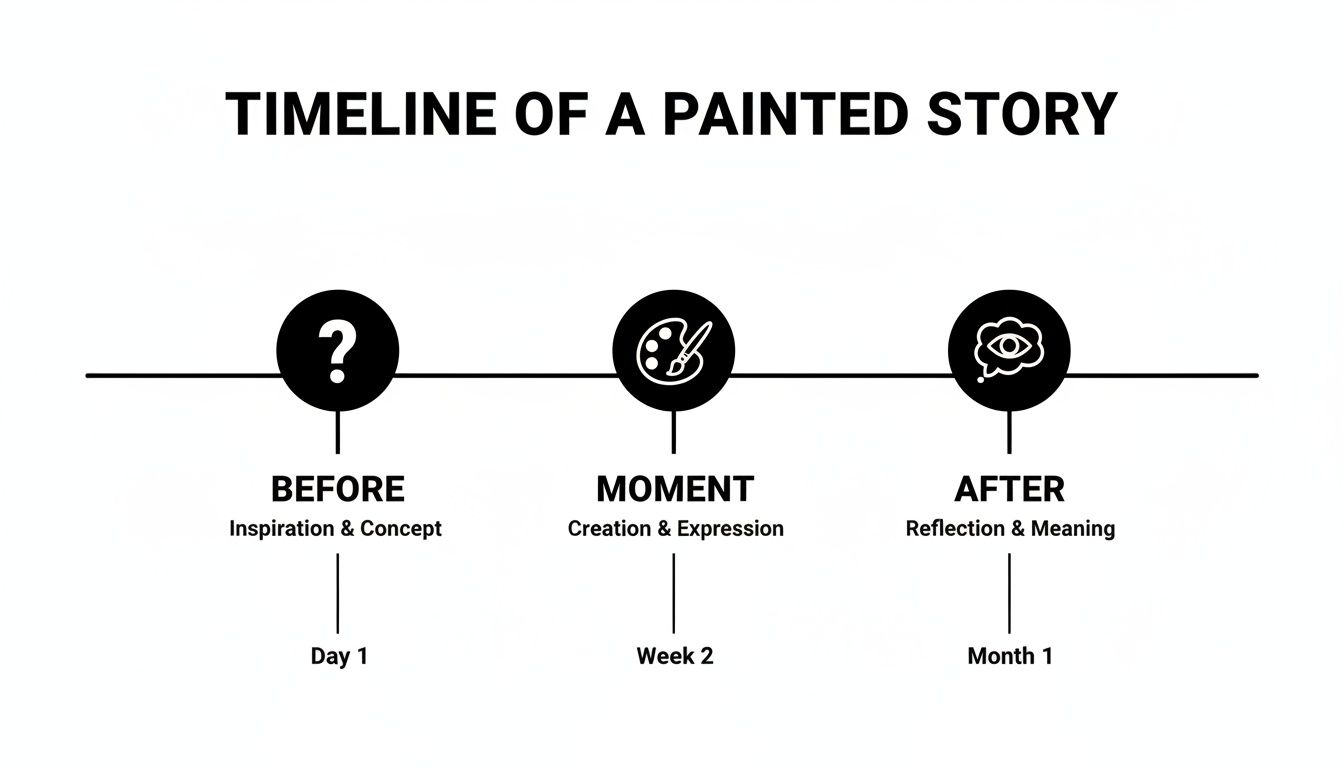
It shows how a static image invites us to imagine what happened just before the captured moment and what might come next, creating a complete story in our minds.
The Modern Narrative Turn
Contemporary artists carry this tradition forward but often point the narrative inward, exploring intimate emotional landscapes and personal identity rather than grand historical events. An artist like Skyler, for example, builds on this long legacy, using the familiar language of landscape and symbolism to tell new stories of inner resilience and our connection to the world.
Ultimately, the history of narrative art isn't just a sequence of movements. It’s an unbroken conversation about what it means to be human, told one powerful image at a time.
Decoding the Canvas: Key Elements of Narrative Painting

Learning to "read" a painting is a skill. Once you know what to look for, you can start to see the story hidden in plain sight. Artists are storytellers, and they have a whole toolkit of visual techniques they use to guide you through a scene and make you feel something.
These individual elements don’t work in isolation. Instead, they weave together to turn a single, frozen moment into a living, breathing narrative. By understanding how artists use composition, symbolism, and body language, you can shift from just looking at a painting to truly experiencing it. This is how you unlock the deeper meaning in any work, whether it’s a centuries-old masterpiece or a piece from a contemporary artist.
Composition and Focal Points
Think of composition as the unseen blueprint of a painting. It’s how the artist deliberately arranges everything on the canvas—figures, objects, light, and shadow—to control your gaze. They use clever tricks like leading lines or placing key elements off-center to create a visual path, pulling your eye toward the most important part of the story.
A canvas is much like a stage, and the artist is the director. They place the actors and props precisely where they’ll have the most dramatic impact, making sure you don't miss the climax. A great composition doesn’t just look good; it makes the story feel clear and immediate, drawing you straight into the heart of the action.
Symbolism and Metaphor
In narrative art, a simple object is almost never just a simple object. Artists use symbolism to pack everyday things with layers of meaning, giving the story a richness it wouldn't otherwise have. A wilting flower might hint at fading beauty or lost love, a single key could represent a secret or a newfound sense of freedom, and a ship on the horizon might stand for a long journey or an unavoidable change.
Symbolism is the artist's way of speaking to our shared human experience. It’s an invitation to look past the surface and connect with the work on a deeper, more personal level, unlocking a story that feels both specific and universal.
These visual metaphors build a kind of silent language between you and the artist. Picking up on them is key to grasping the full story. For instance, in Skyler's work, the recurring image of the sea often serves as a powerful symbol for both the overwhelming force of emotion and the quiet promise of healing. These motifs, along with other tactile details, are part of the artistic vocabulary; artists even explore how to create texture in paintings to add another layer of sensory information to the story.
Body Language and Expression
Since paintings can't speak, artists have to master the universal language of the body. The subtle tilt of a head, the tension in a hand, or the briefest glance between two figures can tell you everything you need to know about their feelings, their relationships, and what they’re about to do.
A clenched fist might scream anger, while slumped shoulders convey a quiet despair. These non-verbal cues are what give the characters life within the confines of the canvas. By paying close attention to how people are posed and how they interact, you can start to piece together the emotional core of the scene. It’s how the artist makes you feel the joy or the pain of their characters as if it were your own.
Why Narrative Art Forges Such a Deep Connection
While a beautiful painting can certainly catch the eye, the art that truly stays with us does more than just look good. For both seasoned collectors and thoughtful designers, narrative art is so compelling because it builds a real, lasting emotional bridge that outlives any passing trend. It doesn't just hang on a wall; it gives a room its heart.
For a collector, bringing a narrative work into their home is like adopting a story. It's not a static object. With every glance, a new detail might surface or a different emotion might be stirred, making the painting a living, breathing part of their environment. It becomes a constant source of discovery and a conversation piece that only deepens in meaning over the years.
The Soul of a Space
Interior designers know that a truly great room is more than just a well-executed color scheme and a chic furniture layout. It needs an emotional center of gravity—a focal point that sets a clear tone and offers a point of view. A painting with a powerful story does this beautifully, turning a decorated house into a genuine home.
A narrative painting injects a human quality into the space. It gives people a reason to stop, think, and let their own imaginations wander, which is an increasingly rare gift in our busy lives. This ability to carve out a moment for reflection is what elevates a room from well-designed to unforgettable.
The real value of narrative art extends far beyond the canvas. For a collector, it’s a living story that reveals itself over time. For a designer, it’s the anchor that gives a space true purpose and makes it feel authentic.
An Investment in Story and Authenticity
When art tells a story, especially from an artist with a distinct and consistent voice, its value becomes far more durable. Decorative pieces can feel dated as tastes change, but work that connects on a deep human level has a timeless appeal. The emotions and stories it taps into are universal.
This is especially true of artists like Skyler, whose entire body of work is built from the raw material of personal experience. When you acquire one of these pieces, you're not just buying a canvas with paint on it. You are becoming a steward of a particular emotional world. That genuine connection is what gives the art its enduring strength.
Understanding how artists turn feeling into a visual language can make this bond even stronger. To go deeper, you can explore art that expresses emotion and see how it actively shapes what we feel. Ultimately, this powerful link between the story, the artist, and the owner is what makes narrative art such a meaningful investment—one that continues to pay emotional dividends for a lifetime.
How to Choose and Display Narrative Art in Your Home

Bringing a story into your home is a different kind of decorating decision. It's not about matching a painting to your sofa; it's about finding a piece that resonates on a deeper level, adding a layer of intellectual curiosity and soul to your environment. The right artwork can transform a well-designed room into a truly personal space.
Start by trusting your own intuition. A powerful narrative painting will almost certainly provoke an immediate feeling or question. Look beyond the colors and composition for a moment and ask yourself what’s happening in the scene. Does it echo a personal memory, a dream for the future, or a familiar emotion?
Selecting a Piece That Speaks to You
When you're looking at narrative art, your personal connection is everything. Forget what you think should work in your space and focus instead on the painting's emotional weight and the story it seems to be telling you.
Here are a few questions I always encourage clients to ask themselves:
- What is my gut reaction? Notice if you feel a sense of calm, excitement, curiosity, or even unease. That first emotional ping is often the most honest sign of a real connection.
- What story is unfolding for me? Your interpretation becomes part of the artwork's journey once it's in your home. Give your imagination the freedom to engage with the characters and setting.
- Will this piece keep me looking? The very best narrative art invites you back time and again, letting you discover new details and subtle shifts in meaning over the years.
If you'd like to explore this idea further, our guide on how to choose art for your home offers more practical advice for finding pieces that truly fit your life.
Displaying Art to Inspire Conversation
Once you've found your piece, where you hang it is just as important as the art itself. Proper placement can amplify its impact, creating a space for both quiet reflection and lively discussion.
The goal of displaying narrative art is to create a moment of pause. Position the work where it can be seen without distraction, allowing viewers the space to connect with the story on the canvas.
Think about placing the artwork in a spot with good, intentional lighting where people tend to gather, like a cozy reading nook or the main wall of a living room. A single, powerful painting hung at eye level often works best as a focal point, especially with ample blank space around it.
This approach gives the story room to breathe. It invites people to step closer, to look deeper, and to forge the very connection that makes what is narrative art such a powerful and enduring form.
Frequently Asked Questions About Narrative Art
As you begin to explore narrative art, a few common questions naturally come to mind. It’s a fascinating genre, but its boundaries and definitions can sometimes feel a bit fluid.
Let’s clear up some of the most frequent inquiries we hear from new enthusiasts and seasoned collectors alike.
Can Abstract Art Be Narrative?
This is a great question, and the answer is a resounding yes. While we often link storytelling with clear figures and scenes, abstract art tells its stories through a different language—one of color, form, and texture.
Think of it this way: an artist can use a storm of chaotic, sharp angles to convey a feeling of conflict, or they might use soft, flowing lines to evoke a sense of peace and resolution. The narrative is less about a literal plot and more about an emotional journey, inviting a deeply personal interpretation from you, the viewer.
Does Narrative Art Always Depict a Famous Story?
Not at all. In centuries past, it was common for painters to illustrate well-known myths, religious parables, or major historical events. That was the shared cultural language of the time.
Today, however, contemporary narrative art is far more likely to focus on personal, internal, or even imagined stories. The real power of modern narrative work is in its ability to tap into a universal human emotion or situation, whether the specific "plot" is familiar or entirely new.
A key part of experiencing narrative art is your own interpretation. The artwork is a catalyst for the story that unfolds in your mind. Your personal connection is just as valid as the artist's original idea.
Is Narrative Art a Good Investment?
Art that tells a compelling story often creates a much deeper, more lasting connection with collectors, which in turn helps it hold value over time. While any art purchase carries inherent risks, pieces with a strong narrative element tend to be less vulnerable to fleeting trends.
They resonate on a human level that outlasts passing fads. If you're looking for some guidance on where to begin, our article on the best places to buy original art online is a great resource for navigating your search with confidence.
Ready to discover art that tells a story? Explore the gallery at Skyler’s Art and find an original piece that speaks to you. https://skylers-art.org