How to Identify Artist Signatures A Collector’s Guide
Before you ever reach for a database or a magnifying glass, your most important tool for authenticating a signature is a careful, practiced eye. The initial visual assessment—examining a signature's placement, style, and medium within the context of the entire artwork—is a foundational skill. This first look can immediately reveal tell-tale signs of a forgery or, conversely, build confidence in a work’s authenticity.
Your First Look at an Artist's Signature
The world of art collecting can be a minefield. According to the Fine Art Expert Institute, a staggering 50% of all art in circulation is believed to be either forged or misattributed. This isn't just a hypothetical problem; it has real-world consequences. Take the case of the Étienne Terrus Museum in France, which made headlines in 2018 after discovering that nearly 60% of its collection—a total of 82 paintings—were fakes.
This is why developing a keen eye for signatures is not just a skill, but a necessity for any serious collector.
Where to Find the Signature
Most people expect to find a signature in the lower right or left corner, a convention that keeps it from distracting from the main composition. While that’s often the case, artists are individuals, and their habits can be just as unique as their brushstrokes.
Always check these other common spots:
- Within the composition: An artist might cleverly weave their name or initials into the scene itself—hidden in a shadow, written on a signpost, or etched into an object.
- On the reverse: Many artists sign, date, and even title their work on the back of the canvas or paper. This is especially common for works on paper.
- Along the edges: Sometimes a signature is tucked away on the stretcher bar or the side of a deep canvas, only becoming visible when the work is unframed.
A signature's location is a piece of the puzzle. Michelangelo, for instance, famously chiseled his name onto a sash across Mary's chest in his Pietà—the only work he ever signed. This unconventional choice tells its own story.
This simple workflow is a great starting point for any initial inspection.
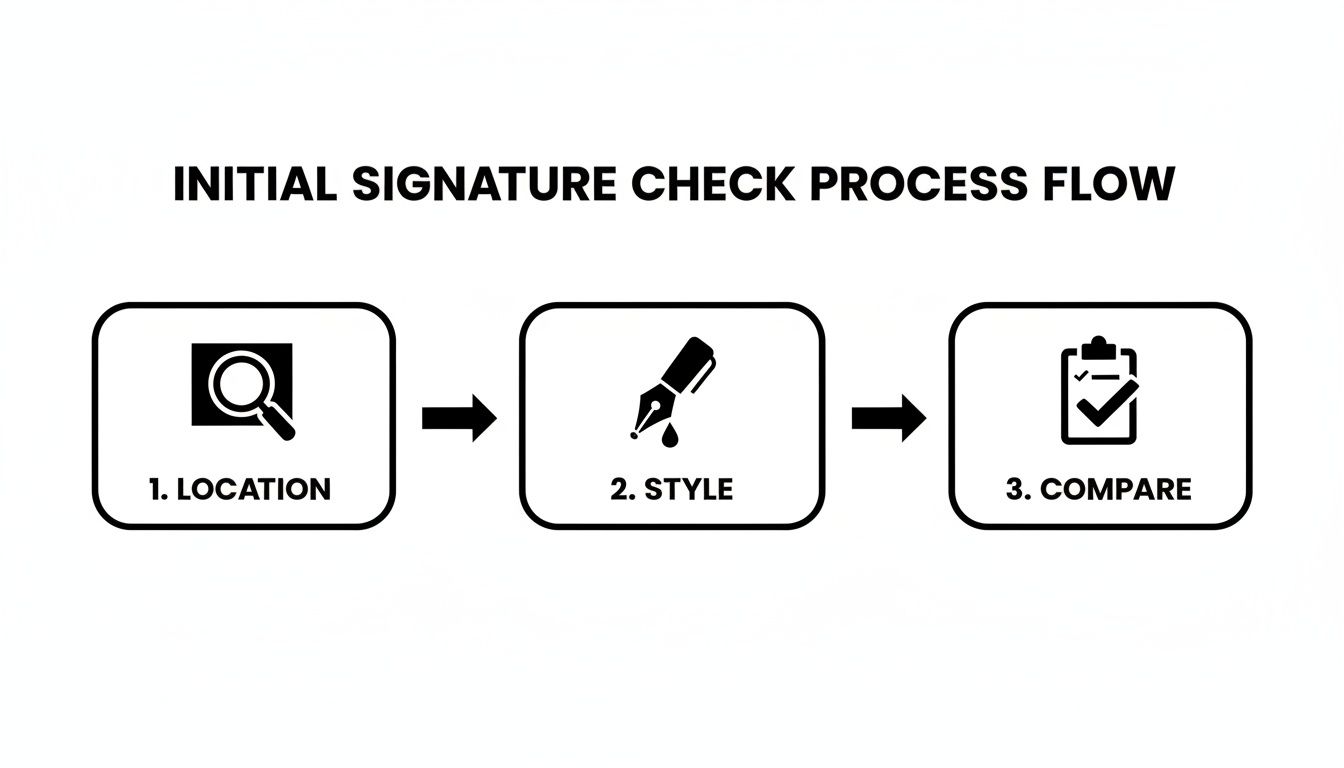
As the diagram shows, the process is straightforward: locate the mark, analyze its style and medium, and then prepare to compare it against verified examples.
Analyzing Signature Style and Medium
Once you’ve found the signature, it’s time to scrutinize its character. An authentic signature, applied with the confidence of muscle memory, usually has a certain fluidity. The lines feel dynamic and assured. A forger, on the other hand, is often drawing, not writing. Their attempts to copy a signature can result in slow, hesitant, or shaky marks that betray a lack of natural rhythm.
Pay close attention to pressure and medium. A genuine signature applied with a brush or pen will naturally show variations in pressure, with some parts of a letter being thicker or thinner. A signature that appears to have a completely uniform line weight might be a red flag for a copy or a print.
The table below summarizes the key visual clues to look for during this initial examination.
Key Visual Signature Characteristics
| Characteristic | What to Look For | Red Flag |
|---|---|---|
| Flow & Rhythm | Confident, fluid, and consistent strokes. | Slow, hesitant, shaky, or drawn-out lines. |
| Pressure | Natural variations in line thickness and thinness. | Uniform pressure with no variation; overly consistent lines. |
| Medium | The signature medium matches the artwork (e.g., oil on oil). | Mismatched media (e.g., marker on an 18th-century painting). |
| Placement | Integrated into the work, on the reverse, or in a typical corner. | Placed awkwardly on top of aged varnish or cracks. |
| Integration | Appears to be part of the original paint layer. | Sits on the surface, looking "newer" than the surrounding art. |
Considering these elements will give you a solid foundation for your assessment.
The medium itself is also a critical piece of evidence. Best practice dictates that an artist signs a work with the same medium used to create it—oil paint on an oil painting, watercolor on a watercolor, and so on. A signature in permanent marker on an old canvas is immediately suspicious, not only because the marker ink may not have existed when the work was supposedly created, but also because it is not an archival material. These are the kinds of details that are crucial when you want to choose art that will last.
Essential Tools for Signature Verification
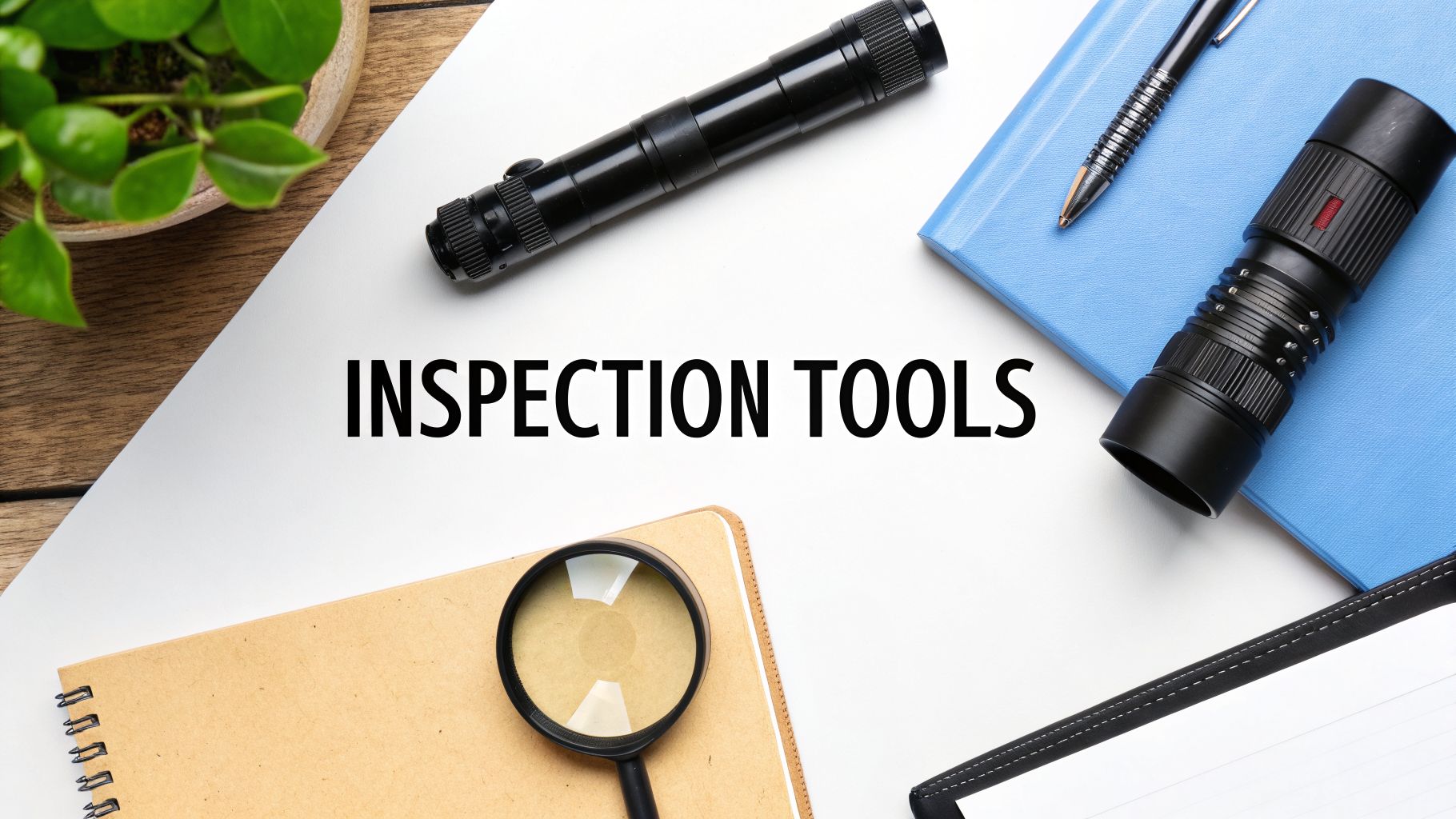
While your eyes are your first and best tool, they can sometimes be deceived. To truly understand a signature's authenticity, you need to look closer than the naked eye allows. This is where you move from simple observation to a more technical examination. Fortunately, the essential tools for this are not all high-tech lab equipment; many are simple devices and lighting techniques that can reveal what the artist—or a forger—never intended for you to see.
Start with Magnification
The most basic, yet most powerful, tool in your kit is a good quality magnifying glass. For serious work, I always recommend a jeweler’s loupe. Magnification is your window into the microscopic construction of the signature. An authentic, fluid signature applied with confidence will still have tiny, natural variations in the paint or ink.
This is also your best defense against common forgeries. A signature that was slowly and carefully traced, for instance, often shows microscopic hesitations, unnatural pressure, or shaky lines that are completely invisible otherwise. You might also spot a mechanical uniformity in the line that feels out of place for a period-appropriate dip pen or brush.
Use Raking Light to Reveal Texture
One of the most effective and affordable techniques I use is raking light. This is a simple but brilliant method. You just hold a strong, focused light source—like an LED flashlight—at a very low, sharp angle to the artwork’s surface. This technique casts long shadows across every bump and groove, creating a topographic map of the surface.
This is incredibly useful for one critical test: determining if a signature was added long after the painting was finished and varnished.
- Varnish Layers: A genuine signature should be part of the painting, lying beneath the final varnish layer. If raking light reveals a signature sitting glossy and proud on top of an old, cracked varnish, it’s an almost certain sign it was added later.
- Paint Impasto: The light also shows how the signature interacts with the texture of the paint around it. A real signature will settle into the microscopic peaks and valleys of the dried paint beneath it. A forgery might look like it’s “bridging” these gaps in an unnatural way.
Imagine you're looking at an 18th-century portrait. With raking light, you notice the signature appears smooth and almost wet, while the paint around it has a fine, aged crackle pattern (craquelure). The light clearly shows the signature sitting on top of those cracks instead of being a part of them. This is a massive red flag pointing to a later addition.
A simple flashlight can transform your subjective opinion into a much more scientific examination of the object's physical history.
Look Deeper with Specialized Light
For a more definitive analysis, specialized light sources like ultraviolet (UV) and infrared (IR) can offer compelling evidence. These tools were once exclusive to conservation labs but are now more accessible to dedicated collectors.
Ultraviolet (UV) Light
A handheld UV light, often called a blacklight, makes different materials fluoresce (or glow) in distinct ways. Older, natural resin varnishes typically glow with a cloudy, greenish-yellow color. In contrast, most modern synthetic varnishes and paints fluoresce with a much brighter, purplish-white light. If a signature glows brilliantly while the rest of the painting has that dull, aged fluorescence, it’s a strong indication the signature is a recent addition.
Infrared (IR) Light
Infrared can often see right through the top layers of paint, revealing what’s hidden underneath. Its greatest value is in detecting underdrawings—the artist's preliminary sketches on the canvas. If an IR camera reveals a perfectly traced outline of the signature beneath the final mark, it suggests a painstaking forgery, not a spontaneous, authentic autograph.
These tools provide invaluable data, but remember they are just one part of your overall investigation. To keep all your research, images, and notes in one place, you might find a specialized app for artists helpful for managing your collection and its documentation.
Using Research and Databases to Confirm Authenticity
A signature viewed in a vacuum is just a scribble. Its real value for authentication emerges only when you hold it up against known, verified examples. While a careful visual exam and specialized tools can get you started, confirming a signature’s legitimacy is a job for a detective, not just an observer. This is where you dig into the historical record to find evidence that either supports or refutes what your eyes are telling you.
Your first and most important stop should be the artist's catalogue raisonné. If you’re not familiar with this term, it’s the single most authoritative resource you can find. It is a comprehensive, scholarly publication listing every known work by an artist, compiled by the world's foremost experts on that individual.
The Power of the Catalogue Raisonné
Think of a catalogue raisonné as the definitive encyclopedia for an artist's entire output. It goes far beyond simple pictures. Each entry is packed with details: title, date, medium, dimensions, and—most critically—its provenance, or ownership history. It provides high-quality photographs of the artwork and, crucially, its signature. This allows you to perform a direct, side-by-side comparison with a gold-standard reference from the exact period you're investigating.
Finding the right catalogue can take some effort:
- Major Art Libraries: Start with specialized libraries like the Frick Art Reference Library in New York or the art history department of a major university. They often hold print editions.
- Digital Catalogues: The International Foundation for Art Research (IFAR) keeps a running list of published catalogues raisonnés, which can point you to both print and digital versions.
- Artist Foundations: The official estate or foundation managing an artist’s legacy is frequently involved in producing and updating the catalogue.
When you have the catalogue in hand, don't just look for one perfect match. An artist's signature is not a rubber stamp. Review several entries from the same time frame to get a feel for the natural variations and consistencies in their handwriting.
Leveraging Digital Databases and Auction Records
While catalogues raisonnés are the academic ideal, they aren't always accessible. Fortunately, a massive amount of information is available online. Major auction houses like Christie's and Sotheby's maintain searchable databases of past sales that are an absolute treasure trove for researchers.
Here, you can find high-resolution images of authenticated works that have appeared on the market, letting you trace the evolution of an artist's signature over their entire career. You might discover, for instance, that an artist used a simple initial on early drawings but developed a more formal, full-name signature on major oil paintings later in life. This context is everything.
A signature’s style often changes. An artist’s mark from their 20s might look entirely different from their signature at age 60. Judging a piece based on a single, out-of-context example is a common and costly mistake.
For high-stakes authentications, research often pairs with scientific analysis. Firms like ArtDiscovery specialize in this, combining deep historical investigation with forensic techniques.
This level of rigor shows just how much is on the line. The art and autograph collectibles market is a serious industry, valued at $4.2 billion in 2024 and projected to hit $6.5 billion by 2030. In such a high-value environment, scientific proof can be the final word. For example, ArtDiscovery's analysis of a René Magritte painting, detailed in this in-depth report on art authentication, confirmed the signature and helped lift its auction estimate from $600,000 to a final sale price of $1.134 million.
Beyond auction houses, don’t overlook dedicated signature databases and museum collection portals. Museums offer high-resolution images of works with vetted provenance and expert notes, making them a highly reliable source. Your goal is to build a solid portfolio of legitimate signatures from the correct era. This is the only way to make a truly informed comparison. Of course, knowing where to buy original paintings from trusted dealers in the first place gives you a much stronger starting point.
The Role of Provenance and Modern Technology
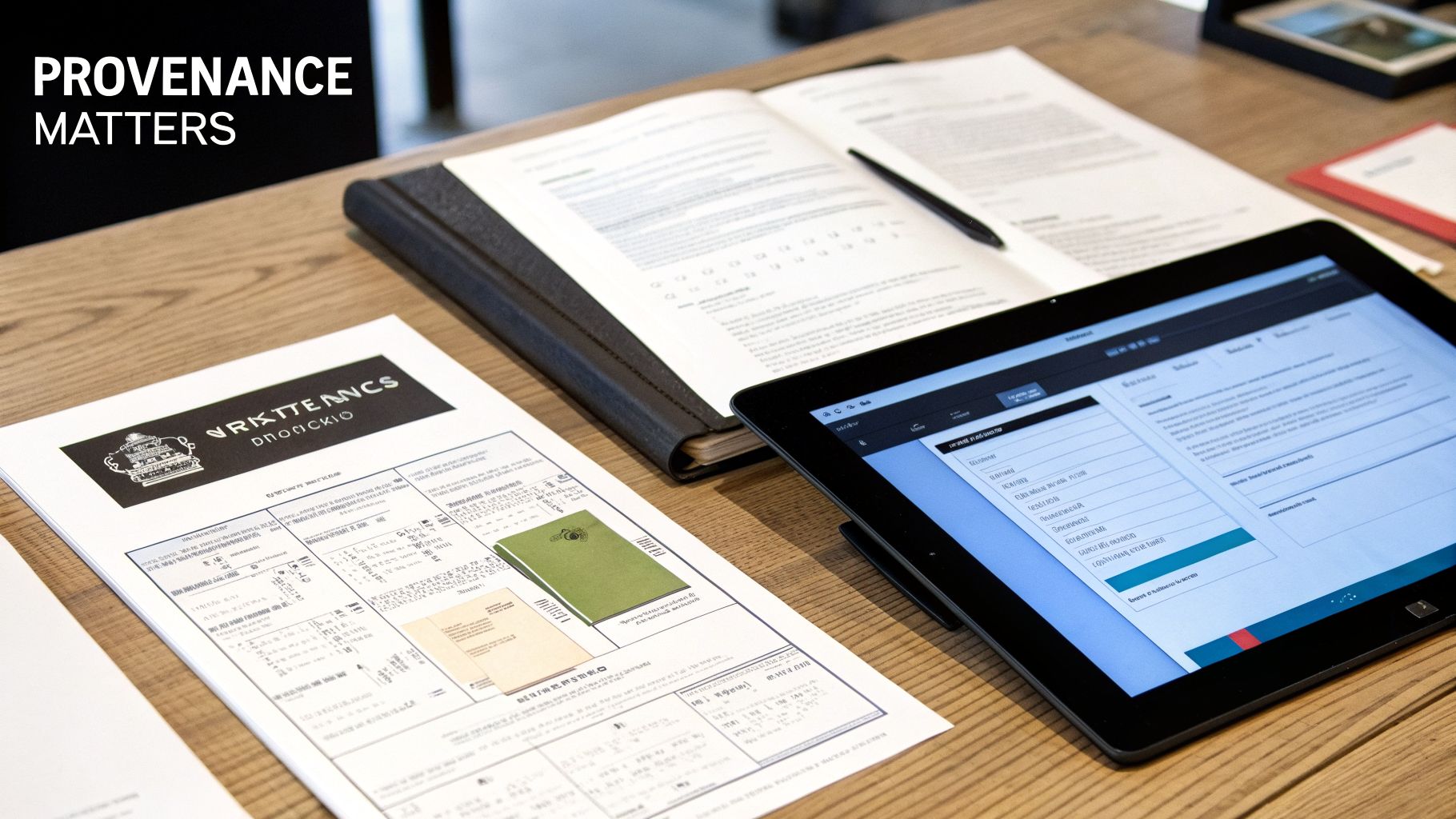
A signature might seem like the final word on who created a painting, but in the art world, it’s really just the beginning of the investigation. An artwork's true credibility is deeply rooted in its provenance—the documented chain of ownership that traces its history from the moment it left the artist's studio.
Without this paper trail, even a signature that looks perfect under a magnifying glass is suspect. Think of it as an artwork's professional resume; any unexplained gaps in its history are immediate red flags that demand serious attention.
Building the Case with Documentation
A strong provenance isn't built on stories; it's built on verifiable paperwork. When you're assessing a work, your job is to become a historian, actively seeking out and scrutinizing every document that anchors the piece to a specific time and place.
Here are the kinds of documents that build a compelling case:
- Gallery and Dealer Receipts: An original bill of sale from a reputable gallery that represented the artist is one of the strongest pieces of evidence you can find.
- Exhibition Catalogs: If the work was ever shown publicly, a mention in the exhibition catalog confirms its existence and attribution at that point in time.
- Letters from the Artist: Any correspondence where the artist mentions the specific piece is an invaluable, direct link to its creation.
- Previous Appraisal Documents: Past appraisals from certified experts can add layers to the work's history, though I always recommend re-evaluating their findings with fresh eyes.
This kind of documentation transforms an isolated object into a piece with a recorded past. The thrill of uncovering this history can be just as rewarding as discovering beautiful original acrylic paintings for sale straight from a contemporary artist's studio.
The Pitfalls of Certificates of Authenticity
Now, a word of caution about one of the most common—and misunderstood—documents: the Certificate of Authenticity (COA). While a legitimate COA is incredibly valuable, its worth is tied completely to who issued it. Remember, it's far easier to forge a piece of paper than it is to forge a decades-old painting and signature.
Be extremely wary of generic certificates issued by the seller or a gallery without specific, recognized expertise in that particular artist. A truly meaningful COA comes directly from the artist, their official estate, or an independent scholar who has published research on the artist and is a recognized authority.
A proper COA is never vague. It should include the artwork’s title, dimensions, medium, and a high-quality photograph of the piece. Crucially, it must also state the issuer’s credentials and contact information, making them professionally accountable for their opinion.
The Future of Verification: Blockchain and AI
As the art market grows, new tools are emerging to support the foundational work of provenance research. Authenticating signatures is no longer just about dusty archives; it now blends old-school detective work with powerful new systems.
Blockchain technology, for instance, is creating immutable digital records for artworks. Every sale and change of ownership is recorded as a permanent, decentralized "block" of data. This digital trail is virtually tamper-proof, offering a new level of security that is especially relevant for digital art and NFTs.
This isn’t just a niche trend. The Art Basel/UBS report noted that global art sales hit $67.8 billion in 2022, with technology helping to improve price transparency and track provenance. Pioneering firms are already merging this with forensic science. ArtDiscovery, for example, has assisted over 5,200 clients since 2009 by combining AI with scientific analysis to underwrite more than $1 billion in art. This fusion of human expertise and advanced technology is undoubtedly shaping the future of art verification.
Knowing When to Consult an Art Professional
Even the most dedicated research hits a ceiling. You can have a great eye and a solid set of tools, but there comes a moment in the life of every serious collector when you need to bring in a specialist. Recognizing that moment isn't an admission of defeat; it’s the sign of a smart, responsible owner who understands the stakes. Making the wrong call on your own can be an incredibly costly mistake, both financially and for the artwork's history.
In many ways, the final step in identifying a signature is getting a professional opinion. Certain situations simply demand it. If you believe you have a high-value piece on your hands, for example, formal authentication is non-negotiable for insurance, future sales, and your own peace of mind. The same goes for works with a tangled, thin, or nonexistent history—only a true specialist can cut through that kind of ambiguity.
I’ve seen collectors spend months chasing down a signature, only to end up with more questions than answers. The second you find yourself stuck, unable to reconcile conflicting evidence—like a signature that looks right but feels out of place for the period—it’s time to call for an expert. It’s the single best way to protect your investment and the artwork itself.
Appraisers, Conservators, and Authenticators
The world of art experts isn't one-size-fits-all, and calling the right person for the right job is critical. Each professional offers a distinct type of expertise.
An art appraiser is your go-to for valuation. Their primary role is to determine an artwork's fair market value for insurance, estate, or sales purposes. They do this by analyzing the artist's market, recent auction records, and the work's condition. While they will consider authenticity as part of their assessment, their ultimate goal is to assign a dollar value, not to conduct a forensic investigation.
Think of a conservator as a physician for your artwork. With a deep background in material science, they specialize in the physical health and preservation of art. A conservator can perform technical analysis, looking at paint layers under a microscope or using infrared and X-ray tools to see what lies beneath the surface. Their findings can provide hard scientific evidence about whether a signature is original to the work or was added later.
Finally, an authentication service or an independent scholar who specializes in a single artist is the ultimate authority on attribution. These experts and committees have often dedicated their entire careers to one artist's body of work. They are the ones who typically maintain the definitive catalogue raisonné and are considered the last word on whether a piece is genuine.
Demystifying the Process and Costs
Reaching out to a professional might feel daunting, but the process is usually quite structured. It starts with an initial query where you'll share high-resolution photos and all the provenance and research you've gathered. From there, the expert will propose a path forward and give you an estimate of the costs.
Those costs can vary significantly based on the work involved:
- Appraisals: Most appraisers charge an hourly rate, which typically falls between $150 and $500+ per hour. Some may offer a flat fee for a standard valuation report.
- Scientific Analysis: Technical examinations like pigment analysis or infrared reflectography are specialized services that can cost anywhere from several hundred to a few thousand dollars.
- Formal Authentication: Submitting a work to an artist's foundation or an official authentication board is the most intensive option and can cost thousands, reflecting the exhaustive research required.
While it’s a significant expense, professional verification is a small fraction of a valuable artwork's potential worth. It’s the final and most important act of due diligence. As someone who values the integrity of art, I’ve always found that the collectors who build the most reputable collections are the ones who respect the process enough to invest in expert opinion. You can also develop your eye by visiting well-curated collections; you can learn more about one such space by exploring the Grand Hand Gallery.
Common Questions About Artist Signatures
Even with a solid method for examining signatures, a few tricky questions always seem to pop up. It’s only natural. The journey of verifying an artwork is full of nuances, from beautiful paintings that bear no name at all to the way an artist’s handwriting can shift and change over a lifetime.
Let's walk through some of the most common scenarios you’ll likely encounter. Getting these right can be the difference between a confident acquisition and a costly mistake.
What Should I Do If a Painting Is Unsigned?
First, don't panic. An unsigned artwork is far from a dead end; in fact, it’s surprisingly common. Many great artists simply didn't sign every single piece. Some felt the work stood on its own, while others considered certain studies or preparatory sketches to be just that—not "finished" works that warranted a formal signature.
When you find yourself with an unsigned piece, your investigation just shifts its focus. The signature is off the table, so you have to lean more heavily on other compelling forms of evidence.
Your investigation will pivot to three key areas:
- Provenance: This is the artwork’s life story—its documented history of ownership. A strong paper trail with old gallery receipts, exhibition catalogs, or personal letters mentioning the work can be even more powerful than a signature.
- Stylistic Analysis: This is where you really need to get to know the artist. Meticulously compare the brushwork, the color palette, the choice of subject matter, and the overall composition to their known, authenticated works. Does it feel right?
- Material Analysis: Look at the physical object itself. Are the canvas, paper, and pigments consistent with the materials the artist used during that specific time period? For scientific certainty, a conservator’s analysis is invaluable here.
An artist’s catalogue raisonné—the definitive, scholarly inventory of their work—is an essential resource in this situation. These volumes often include known unsigned pieces. If you gather enough strong evidence pointing to a specific creator, the next step is to approach the artist's foundation or a recognized scholar for formal attribution.
Does an Artist’s Signature Change Over Time?
Yes, absolutely. An artist's signature is almost expected to evolve throughout their career. The changes can be subtle or quite dramatic, and they happen for all sorts of reasons. One of the biggest mistakes a new collector can make is relying on a single signature example as the definitive model.
Early in their careers, many artists used simple initials or a more straightforward version of their name. As their fame grew, they often developed a more stylized or consistent "brand." James McNeill Whistler, for example, famously went from using his name to a distinctive butterfly monogram, which itself went through several iterations over the years.
Think of a signature's evolution as part of the artist's story. A shift in medium—from pencil on paper to oil on a massive canvas—can change everything. So can a new artistic period, personal branding, or even the physical effects of aging. This is precisely why you must compare a signature against multiple verified examples from different decades of an artist's life.
How Reliable Is a Certificate of Authenticity (COA)?
The value of a Certificate of Authenticity depends entirely on who issued it. A COA can be ironclad proof of an artwork’s legitimacy, or it can be a completely worthless piece of paper designed to deceive. The secret is to scrutinize the issuer, not just the document itself.
A COA carries real weight only when it comes from:
- The artist themselves.
- The artist’s official estate or foundation.
- A widely recognized, independent scholar or expert who has published authoritative research on the artist (like the author of the catalogue raisonné).
Be extremely wary of generic COAs offered by a seller or gallery with no specific, documented expertise in that particular artist. Forgers know it's far easier to fake a document than it is to fake a convincing painting. A legitimate COA will always contain specific details—title, medium, dimensions, a high-quality image of the work—along with the full credentials and contact information of the issuer.
Are Forged Signatures Easy to Spot?
Some are clumsy and obvious, but many forgeries are incredibly sophisticated and can fool even a seasoned eye. Professional forgers are known to practice a signature hundreds of times, learning to mimic its natural rhythm and flow. With some market estimates suggesting that up to 50% of art in circulation may be fake or misattributed, you have to approach every signature with a healthy dose of skepticism.
That said, even the best forgeries often contain subtle tells that give them away under close examination.
Look for these red flags:
- Hesitation Marks: You might see slow, shaky lines or tiny breaks where the forger was carefully drawing the signature instead of writing it fluidly.
- Uniform Pressure: A signature made with a modern pen can show an unnaturally even ink flow, unlike the variable pressure and character you’d see from a paintbrush or an old-fashioned dip pen.
- Anachronisms: A common blunder is adding a signature style to a painting from the wrong period of the artist’s career—for example, using a late-career signature on an early-career work.
Ultimately, learning how to identify artist signatures is a skill built from combining careful visual examination with diligent research. When the stakes are high, never hesitate to bring in a professional for an expert opinion. Every signature has a story, and it’s your job to make sure you’re reading the right one.
At Skyler’s Art, every painting is an authentic expression, signed with intention and care. Each piece comes directly from the artist's studio, providing an unbreakable link of provenance and a story you can trust. Explore the collection of original, emotive works at https://skylers-art.org.